Today's
EarthStation1.com 15% Off Commemorative Memorial Title: Women's
Rights Women's Suffrage The Women's Movement MP4 Download DVD
Today, November 25, 2025
November 25: International Day For The
Elimination Of Violence Against Women: -- A day that promotes
respect and dignity for women, a vital movement that strives to
create a world where every woman feels safe, valued, and
empowered. On November 25, 1960, the Mirabal sisters of the
Dominican Republic were assassinated by henchmen of dictator
Rafael Trujillo. The sisters, who had been active in movements
against the Trujillo regime, were beaten and strangled to death,
then placed in a Jeep that was driven off a mountainous road in
order to make their deaths appear accidental. In December 1999,
the United Nations General Assembly designated November 25 as the
International Day for the Elimination of Violence Against Women.
The date marks the beginning of 16 days of remembrance and
activism, culminating in International Human Rights Day. According
to a report by the United Nations, 19 percent of women between the
ages of 15 and 49 years of age have experienced physical and/or
sexual violence "by an intimate partner." In some cases,
this violence ends in the women's death. Violence against women is
a problem that has been accepted and condoned all throughout human
history. The notion that women were property that could be owned
by a man during Ancient Roman times and even 18th century English
laws that allowed a man to "discipline" his wife and
children with a stick or whip are both examples of the tragedy of
the ways women have been oppressed. It has been a fight for many
centuries for women to be able to function in western society with
equal rights in their homes and in the workplace, without being
subjected to violent acts from men. The 18th and 19th centuries
were important times for the advancement of women's rights. By
1920, the United States had made it illegal for a man to
physically abuse his wife, but it wasn't until the 1970s that
society began to truly give attention to the problem. The 1994
Violence Against Women Act, signed by President Bill Clinton, was
passed in the US to provide services and care for women who were
victims, as well as funding for prosecution of perpetrators of
domestic violence. While many strides have been made in recent
decades, it is important to remember that violence against women
is prevalent all around the world. And in come countries where
women have few rights, violence against them is still legal or
often culturally condoned. The International Day for the
Elimination of the Violence Against Women was established with the
purpose of raising awareness about the fact that women locally and
around the world are subject to violence including domestic abuse,
rape, stalking and more. The hope is that this day will bring the
problem of violence against women to the forefront of people's
minds and continue to offer awareness, prevention, assistance and
solutions all throughout the year. When the Mirabal sisters acted
as resistance fighters and were willing to speak out against the
abusive government of the Dominican Republic, they were brutally
beaten and murdered on November 25, 1960. Then in 1981, when the
observance of the International Day for the Elimination of
Violence Against Women began, the date was set in honor and memory
of these remarkable women. Women's activists began celebrating
this day annually and the event grew throughout that 1980s. The
purpose of the day was meant to raise awareness for and show
opposition to the problem of violence against women, whether in
their own homes as victims of domestic abuse, or in other
situations. By the 1990s, violence against women became an
important part of initiatives of the United Nations. And in the
year 2000, the International Day for the Elimination of Violence
Against Women was declared as an official observance. On Sale @
15% Off Discount Till Midnight PT!
https://store.earthstation1.com/women39s-suffrage-amp-the-women39s-movement-dvd-mp4-usb-39394.html
Today's
EarthStation1.com 15% Off Commemorative Memorial Title: Gimme That
Old Time Christmas! Holiday Films DVD, MP4 Download, USB
Today, November 25, 2025
November 25: Shopping Reminder Day: -- A
day for you to do your shopping at EarthStation1 MediaOutlet!
After you've enjoyed the turkey and cranberry sauce on
Thanksgiving, it's time to make sure you are fully prepared for
Christmas, Hanukkah, or Kwanzaa and finish any last-minute
shopping. If you have holiday shopping to complete, this day is
here to remind you that 1) there are 30 days until Christmas; 2)
there are 31 days until the start of Kwanzaa; and 3) Hanukkah is
coming sooner than you think! We're not 100% sure about the
origins of Shopping Reminder Day, but it's likely linked to Black
Friday. The first recorded use of the term 'Black Friday' was
applied not to holiday shopping but the financial crisis:
specifically, the crash of the U.S. gold market on September 24,
1869. Jay Gould and Jim Fisk, two notoriously unmerciful
stockbrokers on Wall Street, worked together to buy up as much of
the U.S.'s gold as they could, hoping to drive the price as high
as possible and sell it for staggering profits. On that fateful
Friday in September, the scheme was finally brought to light,
causing the stock market to spiral downward and bankrupting
everyone from farmers to Wall Street tycoons. The most well-known
story behind the Black Friday tradition following Thanksgiving
connects it to retailers - after a whole year of operating at a
loss (or being "in the red"), on the day after
Thanksgiving, shoppers splurged so much on marked down products
that stores actually made a profit (or went "into the
black"). Though retail companies indeed used to record losses
in red and profits in black when doing their accounting, this
version of Black Friday's origin is the officially sanctioned --
but inaccurate -- story behind the tradition. By the late 1980s,
Black Friday had stuck and became something positive. On Sale @
15% Off Discount Till Midnight PT!
https://store.earthstation1.com/gimme-that-old-time-christmas-classic-yuletide-holiday-films-dvd.html
Today's
EarthStation1.com 15% Off Commemorative Memorial Title: The
Fabulous Sixties with Peter Jennings TV Docuseries MP4 Or DVD Set
Today, November 25, 2025
November 25, 1965: Thanksgiving Day (US):
Alice's Restaurant Massacree (Alice's Restaurant): -- On
Thanksgiving Day 1965, while in Stockbridge, Massachusetts, during
a break from his brief stint in college, 18-year-old folk music
singer, songwriter and guitarist Arlo Guthrie, son of the famous
folk music singer, songwriter and guitarist Woody Guthrie, is
arrested for illegally dumping on private property what he
described as "a half-ton of garbage" from the home of
his friends, teachers Ray and Alice Brock, after he discovered the
local landfill was closed for the holiday. Guthrie and his friend
Richard Robbins appeared in court, pled guilty to the charges,
were levied a nominal fine and picked up the garbage that weekend.
This littering charge would soon serve as the basis for Guthrie's
most famous work, "Alice's Restaurant Massacree", a
talking blues song that lasts 18 minutes and 34 seconds in its
original recorded version. Guthrie has pointed out that this was
also the exact length of one of the infamous gaps in Richard
Nixon's Watergate tapes, and that Nixon owned a copy of the
record. The Alice in the song is Alice Brock, who had been a
librarian at Arlo's boarding school in the town before opening her
restaurant. She later opened an art studio in Provincetown,
Massachusetts. The song lampoons the Vietnam War draft. However,
Guthrie has stated in multiple interviews that the song is more an
"anti-stupidity" song than an anti-war song, adding that
it is based on a true incident. In the song, Guthrie is called up
for a draft examination and rejected as unfit for military service
as a result of a criminal record consisting solely of one
conviction for the aforementioned littering. Alice and her
restaurant are the subjects of the refrain, but are generally
mentioned only incidentally in the story (early drafts of the song
explained that the restaurant was a place to hide from the
police). Though her presence is implied at certain points in the
story, Alice herself is described explicitly in the tale only
briefly when she bails Guthrie and a friend out of jail. On the
DVD commentary for the 1969 movie, Guthrie stated that the events
presented in the song all actually happened (others, such as the
arresting officer, William Obanhein, disputed some of the song's
details, but generally verified the truth of the overall story).
"Alice's Restaurant" was the song that earned Guthrie
his first recording contract, after counterculture radio host Bob
Fass began playing a tape recording of one of Guthrie's live
performances of the song repeatedly one night in 1967. A
performance at the Newport Folk Festival on July 17, 1967, was
also very well received. Soon afterward, Guthrie recorded the song
in front of a studio audience in New York City and released it as
side one of the album, Alice's Restaurant. By the end of the
decade, Guthrie had gone from playing coffee houses and small
venues to playing massive and prestigious venues such as Carnegie
Hall and the Woodstock Festival. For a short period after its
release in October 1967, "Alice's Restaurant" was
heavily played on U.S. college and counterculture radio stations.
It became a symbol of the late 1960s, and for many it defined an
attitude and lifestyle that were lived out across the country in
the ensuing years. Its leisurely finger-picking acoustic guitar
and rambling lyrics were widely memorized and played by irreverent
youth. Many stations in the United States have a Thanksgiving Day
tradition of playing "Alice's Restaurant". A 1969 film,
directed and co-written by Arthur Penn, was based on the true
story told in the song, but with the addition of a large number of
fictional scenes. This film, also called Alice's Restaurant,
featured Guthrie and several other figures in the song portraying
themselves. The part of his father Woody Guthrie, who had died in
1967, was played by actor Joseph Boley; Alice, who made a cameo
appearance as an extra, was also recast, with actress Pat Quinn in
the title role (Alice Brock later disowned the film's portrayal of
her). Despite its popularity, the song "Alice's Restaurant
Massacree" is not always featured on the setlist of any given
Guthrie performance. Since putting it back into his setlist in
1984, he has performed the song every ten years, stating in a 2014
interview that the Vietnam War had ended by the 1970s and that
everyone who was attending his concerts had likely already heard
the song anyway. So, after a brief period in the late 1960s and
early 1970s when he replaced the monologue with a fictional one
involving "multicolored rainbow roaches", he decided to
do it only on special occasions from that point forward. On Sale @
15% Off Discount Till Midnight PT!
https://store.earthstation1.com/decades-the-1960s-dvd-set-peter-jennings-tv-series-3-19603.html
Today's
EarthStation1.com 15% Off Commemorative Memorial Title: America:
The Second Century Documentary Series DVD, Download, USB
Today, November 25, 2025
November 25, 1835: #BOTD: #HBD! Andrew
Carnegie, Scottish-American business magnate, financier,
industrialist, and philanthropist (d. August 11, 1919) is #born in
Dunfermline, Scotland. Carnegie led the expansion of the American
steel industry in the late 19th century and is often identified as
one of the richest people (and richest Americans) ever. He became
a leading philanthropist in the United States, and in the British
Empire. During the last 18 years of his life, he gave away about
350M USD to charities, foundations, and universities: almost 90
percent of his fortune. His 1889 article proclaiming "The
Gospel of Wealth" called on the rich to use their wealth to
improve society, and stimulated a wave of philanthropy. Carnegie
immigrated to the United States with his parents in 1848. Carnegie
started work as a telegrapher, and by the 1860s had investments in
railroads, railroad sleeping cars, bridges, and oil derricks. He
accumulated further wealth as a bond salesman, raising money for
American enterprise in Europe. He built Pittsburgh's Carnegie
Steel Company, which he sold to J.P. Morgan in 1901 for 480M USD.
It became the U.S. Steel Corporation. After selling Carnegie
Steel, he surpassed John D. Rockefeller as the richest American
for the next couple of years. Carnegie devoted the remainder of
his life to large-scale philanthropy, with special emphasis on
local libraries, world peace, education, and scientific research.
With the fortune he made from business, he built over 2,500
libraries (collectively known as Carnegie Libraries), Carnegie
Hall and the Peace Palace and founded the Carnegie Corporation of
New York, Carnegie Endowment for International Peace, Carnegie
Institution for Science, Carnegie Trust for the Universities of
Scotland, Carnegie Hero Fund, Carnegie Mellon University, and the
Carnegie Museums of Pittsburgh, among others. He once wrote, "The
man who dies rich dies disgraced."; accordingly, he died in
Lenox, Massachusetts, at his Shadow Brook estate, of Bronchial
Pneumonia, aged 83, having already given away 350,695,653 USD
(approximately 5.92B US in 2022) of his wealth. After his death,
his last 30M USD was given to foundations, charities, and to
pensioners. He is buried at Sleepy Hollow Cemetery in Sleepy
Hollow, New York. The grave site is located on the Arcadia Hebron
plot of land at the corner of Summit Avenue and Dingle Road.
Carnegie is buried only a few yards away from union organizer
Samuel Gompers, another important figure of industry in the Gilded
Age. On Sale @ 15% Off Discount Till Midnight PT!
https://store.earthstation1.com/america-the-second-century-us-2nd-100-years-history-621006.html
Today's
EarthStation1.com 15% Off Commemorative Memorial Title: The Birth
Of Europe: Ice Age To 20th Century DVD, Video Download, USB
Today, November 25, 2025
November 25, 1844: #BOTD: #HBD! Karl
Benz, German engine designer, automotive engineer and businessman,
founder of Mercedes-Benz (d. April 4, 1929) is #born Karl
Friedrich Michael Vaillant in Muhlburg, now a borough of
Karlsruhe, Baden-Wurttemberg, which is part of modern Germany.
Also called Carl Friedrich Benz, Karl Benz patented on January 29,
1886 his "Benz Patent Motorwagen", the first
purpose-built gasoline-driven automobile, as DRP-37435:
"automobile fueled by gas", the first automobile
entirely designed as such to generate its own power, not simply a
motorized stage coach or horse carriage which were vehicles
designed to rely on horse power, which is why Karl Benz was
granted his patent and is regarded as the inventor of the
automobile. This is also considered to be the first "production"
vehicle as Benz made several other identical copies. Benz began to
advertise and sell his "Benz Patent Motorwagen" in the
late summer of 1888, making it the first commercially available
automobile in history. In 1870 Siegfried Marcus built the first
gasoline powered combustion engine, which he placed on a pushcart,
building four progressively more sophisticated combustion-engine
cars over a 10-to-15-year span that influenced later cars. Marcus
created the two-cycle combustion engine. The car's second
incarnation in 1880 introduced a four-cycle, gasoline-powered
engine, an ingenious carburetor design and magneto ignition. He
created an additional two models further refining his design with
steering, a clutch and a brake. Nevertheless, these automobiles
were the cobbling-together of the gasoline engine and extant
wheeled vehicles. In 1871, at the age of twenty-seven, Karl Benz
joined August Ritter in launching the Iron Foundry and Mechanical
Workshop in Mannheim, later renamed Factory for Machines for
Sheet-metal Working. The enterprise's first year went very badly.
Ritter turned out to be unreliable, and the business's tools were
impounded. The difficulty was overcome when Benz's fiancee, Bertha
Ringer, bought out Ritter's share in the company using her dowry.
On 20 July 1872, Karl Benz and Bertha Ringer married. They had
five children: Eugen (1873), Richard (1874), Clara (1877), Thilde
(1882), and Ellen (1890). Despite the business misfortunes, Karl
Benz led in the development of new engines in the early factory he
and his wife owned. To get more revenues, in 1878 he began to work
on new patents. First, he concentrated all his efforts on creating
a reliable petrol two-stroke engine. Benz finished his two-stroke
engine on 31 December 1879, New Year's Eve, and was granted a
patent for it in 28 June 1880. Karl Benz showed his real genius,
however, through his successive inventions registered while
designing what would become the production standard for his
two-stroke engine. Benz soon patented the speed regulation system,
the ignition using sparks with battery, the spark plug, the
carburetor, the clutch, the gear shift, and the water radiator.
Benz's lifelong hobby of bicycling brought him to a bicycle repair
shop in Mannheim owned by Max Rose and Friedrich Wilhelm
Esslinger. In 1883, the three founded a new company producing
industrial machines: Benz & Companie Rheinische
Gasmotoren-Fabrik, usually referred to as Benz & Cie. Quickly
growing to twenty-five employees, it soon began to produce static
gas engines as well. The success of the company gave Benz the
opportunity to indulge in his old passion of designing a horseless
carriage. Based on his experience with, and fondness for,
bicycles, he used similar technology when he created an
automobile. It featured wire wheels (unlike carriages' wooden
ones) with a four-stroke engine of his own design between the rear
wheels, with a very advanced coil ignition and evaporative cooling
rather than a radiator. Power was transmitted by means of two
roller chains to the rear axle. Karl Benz finished his creation in
1885. The 1885 version was difficult to control, leading to a
collision with a wall during a public demonstration. The first
successful tests on public roads were carried out in the early
summer of 1886. The next year Benz created the Motorwagen Model 2,
which had several modifications, and in 1889, the definitive Model
3 with wooden wheels was introduced, showing at the Paris Expo the
same year. The second customer of the Motorwagen was a Parisian
bicycle manufacturer Emile Roger, who had already been building
Benz engines under license from Karl Benz for several years. Roger
added the Benz automobiles (many built in France) to the line he
carried in Paris and initially most were sold there. The early
1888 version of the Motorwagen had only two gears and could not
climb hills unaided. This limitation was rectified after Bertha
Benz suggested the addition of a third gear after she famously
became the first person to drive an automobile over a long
distance, rigorously field testing the patent Motorwagen,
inventing brake pads and solving several practical issues during
the 65 miles (105 km) trip. In doing so, she brought the Benz
Patent-Motorwagen worldwide attention and got the company its
first sales. Karl Benz died os a bronchial inflammation at the age
of eighty-four at his home in Ladenburg, Baden, Germany. He is
buried in the Friedhof Ladenburg in Ladenburg, Rhein-Neckar-Kreis,
Baden-Wurttemberg, Germany.
https://store.earthstation1.com/the-birth-of-europe-european-history-from-the-ice-age-to-20th-centu20.html
Today's
EarthStation1.com 15% Off Commemorative Memorial Title: The
American Diary: US History 1895-1933 TV Series DVD MP4 USB Drive
Today, November 25, 2025
November 25, 1846: #BOTD: Carrie Nation,
American activist, noted for attacking alcohol-serving
establishments (most often taverns) with a hatchet, radical member
of the temperance movement, a movement which opposed alcohol
before the advent of Prohibition (d. June 9, 1911) is #born
Caroline Amelia Nation in Garrard County, Kentucky. Often referred
to by Carrie, Carry Nation, Carrie A. Nation, or Hatchet Granny,
Carrie Nation was also concerned about tight clothing for women;
she refused to wear a corset and urged women not to wear them
because of their harmful effects on vital organs. She described
herself as "a bulldog running along at the feet of Jesus,
barking at what He doesn't like", and claimed a divine
ordination to promote temperance by destroying bars. Carrie Nation
died aged 64 at Evergreen Place Hospital and Sanitarium just
outside the city limits of Leavenworth, Kansas, having been
brought there following her collapse during her speech in a Eureka
Springs, Arkansas park. Doctors said the cause of death was
paresis, a vaguely-defined medical condition typified by a
weakness of voluntary movement. She is buried in the southeastern
side of Belton Cemetery in Belton, Missouri. The Woman's Christian
Temperance Union later erected a stone inscribed "Faithful to
the Cause of Prohibition, She Hath Done What She Could" and
the name "Carry A. Nation". On Sale @ 15% Off Discount
Till Midnight PT!
https://store.earthstation1.com/american-diary-complete-us-historytv-series-2-dual-layer-dvd2.html
Today's
EarthStation1.com 15% Off Commemorative Memorial Title: Pope Pius
XII Documentary Eugenio Pacelli Biography DVD, Download, USB
Today, November 25, 2025
November 25, 1881: #BOTD: #HBD! Pope John
XXIII (Latin: Ioannes; Italian: Giovanni), head of the Catholic
Church and sovereign of the Vatican City State from October 28,
1958 to his death in 1963, canonized a saint on Apri 27, 2014 (d.
June 3, 1963) is #born Angelo Giuseppe Roncalli in Sotto il Monte,
a small country village in the Bergamo province of the Lombardy
region of Italy, the fourth of fourteen children born to a family
of sharecroppers. He was ordained to the priesthood on 10 August
1904 and served in a number of posts, as nuncio in France and a
delegate to Bulgaria, Greece and Turkey. In a consistory on
January 12, 1953 Pope Pius XII made Roncalli a cardinal as the
Cardinal-Priest of Santa Prisca in addition to naming him as the
Patriarch of Venice. After Pope Pius XII's death, Roncalli was
unexpectedly elected pope on October 28, 1958, on the anniversary
of Constantine I's victory at The Battle Of The Milvian Bridge, at
age 76 after 11 ballots. He was the first pope to take the
pontifical name of "John" upon election in more than 500
years, and his choice settled the complicated question of official
numbering attached to this papal name. Pope John XXIII surprised
those who expected him to be a caretaker pope by calling the
historic Second Vatican Council (1962-1965), the first session
opening on October 11, 1962. His passionate views on equality were
summed up in his statement, "We were all made in God's image,
and thus, we are all Godly alike." Pope John XXIII died of
peritonitis caused by a perforated stomach at 19:49 local time,
just as a Mass for him finished in Saint Peter's Square below
celebrated by Cardinal Luigi Traglia, at the age of 81, ending a
historic pontificate of four years and seven months. After he
died, his brow was ritually tapped to see if he was dead, and
those with him in the room said prayers. Then the room was
illuminated, thus informing the people of what had happened. The
Italian government announced three days of mourning with flags
half-masted and the closure of offices and schools. Spain
announced ten days of mourning with flags half-masted; Philippines
announced nine days of mourning with flags half-masted; Paraguay
and Guatemala announced three days of mourning; The Republic Of
The Congo declared one day of mourning. He was buried on June 6 in
the Vatican grottos in a tomb located near those of both Pope Pius
X and Pope John Paul II. Two wreaths, placed on the two sides of
his tomb, were donated by the prisoners of the Regina Coeli prison
and the Mantova jail in Verona. On June 22, 1963, one day after
his friend and successor Pope Paul VI was elected, the latter
prayed at his tomb. On December 3, 1963, US President Lyndon B.
Johnson posthumously awarded him the Presidential Medal Of
Freedom, the United States' highest civilian award, in recognition
of the good relationship between Pope John XXIII and the United
States of America. The citation for the medal reads "His
Holiness Pope John XXIII, dedicated servant of God. He brought to
all citizens of the planet a heightened sense of the dignity of
the individual, of the brotherhood of man, and of the common duty
to build an environment of peace for all human kind." On Sale
@ 15% Off Discount Till Midnight PT!
https://store.earthstation1.com/pope-pius-xii-dvd-cardinal-secretary-of-state-eugenio-pacelli1.html
Today's
EarthStation1.com 15% Off Commemorative Memorial Title: Millhouse:
A White Comedy (1971) Richard Nixon Farce MP4 Download DVD
Today, November 25, 2025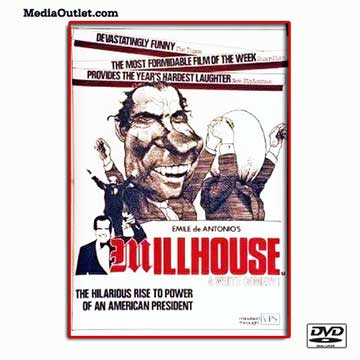
November 25, 1900: #BOTD: #HBD! Helen
Gahagan Douglas, American actress whose portrayal of the villain
in She (1935) inspired the Evil Queen in Snow White and the Seven
Dwarfs (1937), politician first elected to the United States
Congress as a Representative Of California in 1944, and who in her
1950 U.S. Senate election campaign became famous as a symbol of
modern political vitriol as both Gahagan Douglas's Democratic
primary opponent Manchester Boddy and Republican Senatorial
Candidate Richard M. Nixon both referred to her as "pink
right down to her underwear", suggesting Communist sympathies
(d. June 28, 1980) is #born Helen Mary Gahagan in Boonton, New
Jersey, of Scotch-Irish descent. Gahagan Douglas's acting career
included success on Broadway, as a touring opera singer, and in
Hollywood film. She was the eldest daughter of Lillian Rose
(Mussen) and Walter H. Gahagan, an engineer who owned a
construction business in Brooklyn and a shipyard in Arverne,
Queens; her mother had been a schoolteacher. During and after the
Watergate scandal, bumper stickers featuring the legend "Don't
blame me, I voted for Helen Gahagan Douglas" cropped up on
cars in California. In October 1973, Gahagan Douglas was among the
first women featured on the cover of Ms. magazine. At its 1979
commencement ceremonies, Barnard College awarded Gahagan Douglas
its highest honor, the Barnard Medal of Distinction. She died the
following year in New York City aged 79 from breast and lung
cancer, with her husband Melvyn Douglas by her side. Her remains
were cremated, and the ashes given to her widow. On Sale @ 15% Off
Discount Till Midnight PT!
https://store.earthstation1.com/millhouse-a-white-comedy-dvd-1971-richard-nixon-documen1971.html
Today's
EarthStation1.com 15% Off Commemorative Memorial Title: When
Baseball Went To War: Baseball & Its Players During WWII MP4
DVD
Today, November 25, 2025
November 25, 1914: #BOTD: #HBD! Joe
DiMaggio, nicknamed "Joltin' Joe", "The Yankee
Clipper" and "Joe D.", American baseball center
fielder and coach who played his entire 13-year career in Major
League Baseball for the New York Yankees (d. March 8, 1999) is
#born Joseph Paul DiMaggio to Sicilian immigrants in Martinez,
California. He is widely considered one of the greatest baseball
players of all time, and is best known for setting the record for
the longest hitting streak in baseball (56 games from May 15 -
July 16, 1941), a record which still stands. DiMaggio was a
three-time Most Valuable Player Award winner and an All-Star in
each of his 13 seasons. During his tenure with the Yankees, the
club won ten American League pennants and nine World Series
championships. His nine career World Series rings is second only
to fellow Yankee Yogi Berra, who won ten. At the time of his
retirement after the 1951 season, he ranked fifth in career home
runs (361) and sixth in career slugging percentage (.579). He was
inducted into the Baseball Hall of Fame in 1955 and was voted the
sport's greatest living player in a poll taken during baseball's
centennial year of 1969. His brothers Vince (1912-1986) and Dom
(1917-2009) also were major league center fielders. Outside of
baseball, DiMaggio is also widely known for his marriage and
life-long devotion to Marilyn Monroe. Joe DiMaggio died of lung
cancer, having been heavy smoker for much of his adult life, at
home in Hollywood, Florida at age 84. His funeral was held on
March 11, 1999, at Sts. Peter and Paul Roman Catholic Church in
San Francisco, and he was interred 3 months later at Holy Cross
Cemetery in Colma, California. On Sale @ 15% Off Discount Till
Midnight PT!
https://store.earthstation1.com/when-baseball-went-to-war-baseball-and-its-players-during-wwii-mp4-dvd.html
Today's
EarthStation1.com 15% Off Commemorative Memorial Title: CIA The
Secret Files The Central Intelligence Agency TV Series MP4 DVD
Today, November 25, 2025
November 25, 1915: #BOTD: Augusto
Pinochet, Chilean general whose rule remains the longest of any
Chilean leader in history, ruling Chile from 1973 to 1990, first
as the leader of the Military Junta of Chile from 1973 to 1981,
being declared the President of the Republic by the junta in 1974
and becoming the de facto dictator of Chile, and from 1981 to 1990
as de jure President after a new Constitution, which confirmed him
in the office, was approved by a referendum in 1980 (d. December
10, 2006) is #born Augusto Jose Ramon Pinochet Ugarte in
Valparaiso, the son and namesake of Augusto Pinochet Vera
(1891-1944), a descendant of an 18th-century French Breton
immigrant from Lamballe and Avelina Ugarte Martinez (1895-1986), a
woman of Basque heritage. Augusto Pinochet rose through the ranks
of the Chilean Army to become General Chief of Staff in early 1972
before being appointed its Commander-In-Chief on August 23, 1973
by President Salvador Allende. On September 11, 1973, Pinochet
seized power in Chile in a coup d'etat, with the support of the
US, that toppled Allende's democratically elected left-wing Unidad
Popular government and ended civilian rule. In December 1974, the
ruling military junta appointed Pinochet Supreme Head of the
nation by joint decree, although without the support of one of the
coup's instigators, Air Force General Gustavo Leigh. After his
rise to power, Pinochet persecuted leftists, socialists, and
political critics, resulting in the executions of 1,200 to 3,200
people, the internment of as many as 80,000 people, and the
torture of tens of thousands. According to the Chilean government,
the number of executions and forced disappearances was at least
3,095. Operation Condor, a U.S.-supported terror operation
focusing on South America, was founded at the behest of the
Pinochet regime in late November 1975, his 60th birthday. Under
the influence of the free market-oriented "Chicago Boys",
Pinochet's military government implemented economic liberalization
following neoliberalism, including currency stabilization, removed
tariff protections for local industry, banned trade unions, and
privatized social security and hundreds of state-owned
enterprises. Some of the government properties were sold below
market price to politically connected buyers, including Pinochet's
own son-in-law. The regime used censorship of entertainment as a
way to reward supporters of the regime and punish opponents. These
policies produced high economic growth, but critics state that
economic inequality dramatically increased and attribute the
devastating effects of the 1982 monetary crisis on the Chilean
economy to these policies. For most of the 1990s, Chile was the
best-performing economy in Latin America, though the legacy of
Pinochet's reforms continues to be in dispute. His fortune grew
considerably during his years in power through dozens of bank
accounts secretly held abroad and a fortune in real estate. He was
later prosecuted for embezzlement, tax fraud, and for possible
commissions levied on arms deals. Pinochet's 17-year rule was
given a legal framework through a controversial 1980 plebiscite,
which approved a new constitution drafted by a
government-appointed commission. In a 1988 plebiscite, 56% voted
against Pinochet's continuing as president, which led to
democratic elections for the presidency and Congress. After
stepping down in 1990, Pinochet continued to serve as
Commander-In-Chief of the Chilean Army until March 10, 1998, when
he retired and became a senator-for-life in accordance with his
1980 Constitution. However, Pinochet was arrested under an
international arrest warrant on a visit to London on 10 October
1998 in connection with numerous human rights violations.
Following a legal battle, he was released on grounds of ill-health
and returned to Chile on 3 March 2000. In 2004, Chilean Judge Juan
Guzman Tapia ruled that Pinochet was medically fit to stand trial
and placed him under house arrest. By the time of his death, about
300 criminal charges were still pending against him in Chile for
numerous human rights violations during his 17-year rule, as well
as tax evasion and embezzlement during and after his rule. He was
also accused of having corruptly amassed at least 28M USD. Augusto
Pinochet died of congestive heart failure and pulmonary
edema,surrounded by family members, at the Santiago Military
Hospital in Santiago, Chile at 14:15 local time (17:15 UTC), aged
91. Massive spontaneous street demonstrations broke out throughout
the country upon the news of his death. In Santiago, opponents
celebrated his death in Alameda Avenue, while supporters grieved
outside the Military Hospital. Pinochet's remains lay in repose on
December 11, 2006 at the Military Academy in Las Condes. During
this ceremony, Francisco Cuadrado Prats - the grandson of Carlos
Prats (a former Commander-In-Chief of the Army in the Allende
government who was murdered by Pinochet's secret police) - spat on
the coffin, and was quickly surrounded by supporters of Pinochet,
who assaulted him. Pinochet's funeral took place the following day
at the same venue before a gathering of 60,000 supporters. In a
government decision, he was not granted a state funeral (an honor
normally bestowed upon past presidents of Chile) but a military
funeral as former Commander-In-Chief of the Army appointed by
Allende. The government also refused to declare an official
national day of mourning, but it did authorize flags at military
barracks to be flown at half staff, and for the Chilean flag to be
draped on Pinochet's coffin. Socialist President Michelle
Bachelet, whose father Alberto was temporarily imprisoned and
tortured after the 1973 coup and died shortly afterwards from
heart complications, said that it would be "a violation of
[her] conscience" to attend a state funeral for Pinochet. The
only government authority present at the public funeral was the
Defense Minister, Vivianne Blanlot. In Spain, supporters of late
dictator Francisco Franco paid homage to Pinochet. Antonio Tejero,
who led the failed coup of 1981, attended a memorial service in
Madrid. Pinochet's body was cremated in Parque del Mar Cemetery,
Concon, on December 12, 2006, on his request to "avoid
vandalism of his tomb", according to his son Marco Antonio.
His ashes were delivered to his family later that day, and are
deposited in Los Boldos, Santo Domingo, Valparaiso, Chile; one of
his personal residences. The armed forces refused to allow his
ashes to be deposited on military property. On Sale @ 15% Off
Discount Till Midnight PT!
https://store.earthstation1.com/cia-the-secret-files-the-central-intelligence-agency-tv-series-mp4-dv4.html
Today's
EarthStation1.com 15% Off Commemorative Memorial Title: Hate On
Trial: SPLC Vs WAR Trial + Skinhead USA MP4 Download DVD Set
Today, November 25, 2025
November 25, 1915: Racism: Racism In The
United States: Anti-Black Racism: Anti-Black Racism In The United
States: White Supremacy: Terrorism: The Ku Klux Klan (The Klan,
The KKK): -- On Thanksgiving Day 1915, fifteen robed and hooded
"charter members" of the new KKK organization, meet at
the summit of Stone Mountain to create a new iteration of the Ku
Klux Klan. According to sociologist James W. Loewen, Stone
Mountain was "the sacred site to members of the second and
third national klans." Loewen alleges that the rebirth of the
Ku Klux Klan - the second Klan - was inspired by D. W. Griffith's
1915 Klan-glorifying film, The Birth of a Nation.[32] It was
followed in August by the highly publicized lynching of Leo Frank,
a Jewish businessman who had been wrongly convicted of murder, in
nearby Marietta, Georgia. Loewen further alleges that on November
25 of the same year, Thanksgiving Day, a small group, including
fifteen robed and hooded "charter members" of the new
organization, met at the summit of Stone Mountain to create a new
iteration of the Klan. Led by William J. Simmons, it included two
elderly members of the original Klan. As part of their ceremony,
they set up on the summit an altar covered with a flag, opened a
Bible, and burned a 16 ft (4.9 m) cross. James R. Venable attended
the 1915 revival of the KKK on top of Stone Mountain and later
became an Imperial Wizard of the National Knights of the Ku Klux
Klan, which was one of the later KKK factions. He owned land at
the base of the mountain that he had inherited from his ancestors,
and in October of 1923 he granted the Klan an easement with
perpetual right to hold celebrations as they desired. However, the
property was condemned in 1960 at the behest of the Stone Mountain
Memorial Association. The Klan also held cross-burnings at the
summit of the mountain on different occasions from 1915 onward.
This practice came to an end in 1962, when the Klan attempted to
hold a mountaintop cross-burning in response to the NAACP holding
its national convention in Atlanta. The Stone Mountain Memorial
Association did not want either group using state property for
demonstrations, and convinced Governor Ernest Vandiver to order
state troopers to stop the event. Seventy troopers attempted to
stop several hundred Klansmen gathered at the base of the mountain
from climbing to the summit, but the Klansmen were armed with
billy clubs, flashlights, and stones, and greatly outnumbered the
officers. The police negotiated a truce with the local Klan Grand
Dragon, under which the Klansmen would refrain from further
violence, but 20 of their number would be allowed to climb the
mountain for a "religious ceremony", and the
cross-burning was substituted with the lighting of a flare. In
August of 2017, the Klan was denied a permit for a mountaintop
cross-burning. The Ku Klux Klan is the name of three separate
historical and current American white supremacist, far-right
terrorist organizations and hate groups in three non-overlapping
time periods. The Klan was "the first organized terror
movement in American history." Their primary targets are
African Americans, Hispanics, Jews, Latinos, Asian Americans,
Native Americans, Italian Americans, Irish Americans, and
Catholics, as well as immigrants, leftists, homosexuals, Muslims,
atheists, and abortion providers. On Sale @ 15% Off Discount Till
Midnight PT!
https://store.earthstation1.com/hate-on-trial-splc-vs-war-racism-on-trial-mp4-video-download-dvd-se4.html
Today's
EarthStation1.com 15% Off Commemorative Memorial Title: The
History Of Jazz A Video Retrospective DVD, MP4 Download, USB Drive
Today, November 25, 2025
November 25, 1924: #BOTD: #HBD! Paul
Desmond, American saxophonist and composer (d. May 30, 1977) is
#born Paul Emil Breitenfeld in San Francisco, California. He was
an American jazz alto saxophonist and composer, best known for his
work with the Dave Brubeck Quartet and for composing that group's
biggest hit, "Take Five". He was one of the most popular
musicians to come out of the cool jazz scene. In addition to his
work with Brubeck, he led several groups and collaborated with
Gerry Mulligan, Chet Baker, Jim Hall, and Ed Bickert. After years
of chain smoking and poor health, Desmond succumbed to lung cancer
aged 52 in Manhattan, New York following one last tour with
Brubeck. His remains were cremated, and his ashes scattered at an
undisclosed location. On Sale @ 15% Off Discount Till Midnight PT!
https://store.earthstation1.com/the-history-of-jazz-by-billy-taylor-parts-i-amp-ii-dvd.html
Today's
EarthStation1.com 15% Off Commemorative Memorial Title: The
History Of Jazz A Video Retrospective DVD, MP4 Download, USB Drive
Today, November 25, 2025
November 25, 1931: #BOTD: #HBD! Nat
Adderley, African American cornet and trumpet player, an innovator
in the popularization of soul jazz and was one of the most
prolific jazz artists of his time, recording nearly 100 albums,
who proved that cornet could be a modern jazz instrument. (d.
January 2, 2000) is #born Nathaniel Carlyle Adderleyin Tampa,
Florida. He was the brother of saxophonist Julian "Cannonball"
Adderley, whom he remained very close to in his career but under
whose shadow he lived for most of his life. Nat Adderley's "Work
Song" is a jazz standard which also became a success on the
pop charts after singer Oscar Brown Jr. wrote lyrics for the tune.
Nat Adderley died as a result of complications from diabetes at
the age of 68 in Lakeland, Florida. He was interred near his
brother in the Southside Cemetery in Tallahassee, Florida. He was
survived by his wife, Ann; a son, Nat Adderley Jr. of West Orange,
N.J.; a daughter, Alison Adderley-Pittman of Palm Bay, Florida;
and five grandchildren. On Sale @ 15% Off Discount Till Midnight
PT!
https://store.earthstation1.com/the-history-of-jazz-by-billy-taylor-parts-i-amp-ii-dvd.html
Today's
EarthStation1.com 15% Off Commemorative Memorial Title: The Road
To War: Years Between WWI & WWII TV Series DVD, Download, USB
Today, November 25, 2025
November 25, 1936: The Interwar Period
(The Aftermath Of World War I, The Interbellum, Between The Wars):
The Road To War: The Anti-Comintern Pact (The Agreement Against
The Communist International (German: Abkommen Gegen Die
Kommunistische Internationale (German: Antikominternpakt;
Japanese: Bokyo Kyotei; Italian: Patto Anticomintern): -- An
agreement is signed between Germany and Japan directed against the
Communist International (Comintern, also known as the Third
International [1919-1943], an international organization that
advocated world communism that Joseph Stalin, head of the Soviet
Union, dissolved to avoid antagonizing his allies) in which they
commit to collaborate in opposing the spread of Communism,
agreeing to consult on measures "to safeguard their common
interests" in the case of an unprovoked attack by the Soviet
Union against either nation; Italy signs on in 1937, and in 1939
Spain, Hungary and Manchukuo sign. The pact is renewed on the same
day five years later with additional signatories Bulgaria,
Croatia, Denmark, Finland, Nanjing China (Japanese puppet state),
Romania and Slovakia. The Japanese signatories had hoped that the
Anti-Comintern Pact would effectively be an alliance against the
Soviet Union, which is certainly how the Soviets perceived it.
There was also a secret additional protocol which specified a
joint German-Japanese policy specifically aimed against the Soviet
Union. However, after the accession of Fascist Italy to the pact
and especially the German-Soviet rapprochement after the
Molotov-Ribbentrop Pact, it gained an increasingly anti-western
and anti-British identity as well. After August 1939, Japan
distanced itself from Germany as a result of the
Molotov-Ribbentrop Pact. The Anti-Comintern Pact was followed by
the September 1940 Tripartite Pact, which identified the United
States as the primary threat rather than the Soviet Union, however
by December 1941 this too was virtually inoperative. The
Anti-Comintern Pact was subsequently renewed in November 1941 and
saw the entry of several new members into the pact. The Nazi
regime saw signing of the Anti-Comintern Pact as a "litmus
test of loyalty". On Sale @ 15% Off Discount Till Midnight
PT!
https://store.earthstation1.com/the-road-to-war-dvd-set-all-8-tv-shows-4-dis84.html
Today's
EarthStation1.com 15% Off Commemorative Memorial Title: Legacy Of
The Hollywood Blacklist DVD MP4 Download USB Flash Drive
Today, November 25, 2025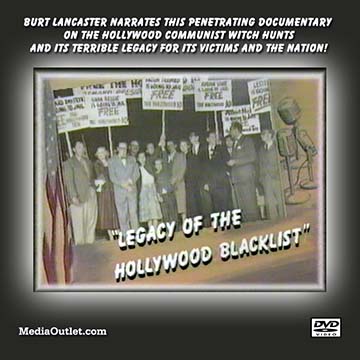
November 25, 1947: The Aftermath Of World
War II: The Cold War: Anti-Communism: Anti-Communism In The United
States: The Red Scare: The Second Red Scare: The Hollywood
Blacklist: The Hollywood Ten: -- Ten individuals who became known
as "The Hollywood Ten" are cited for contempt of
Congress and blacklisted by Hollywood movie studios after refusing
to answer questions about their alleged involvement with the
Communist Party: Alvah Bessie, screenwriter; Herbert Biberman,
screenwriter and director; Lester Cole, screenwriter; Edward
Dmytryk, director; Ring Lardner Jr., screenwriter; John Howard
Lawson, screenwriter; Albert Maltz, screenwriter; Samuel Ornitz,
screenwriter; Adrian Scott, producer and screenwriter; and Dalton
Trumbo, screenwriter. On October 20, the House Un-American
Activities Committee began its investigation into Communist
infiltration of Hollywood, resulting in a blacklist that prevents
some from working in the industry for years. In late September
1947, HUAC subpoenaed 79 individuals on a claim that they were
subversive and the supposition that they injected Communist
propaganda into their films. Although never substantiating this
claim, the investigators charged them with contempt of Congress
when they refused to answer the questions about their membership
in the Screen Writers Guild and Communist Party. The Committee
demanded they admit their political beliefs and name names of
other Communists. Nineteen of those refused to cooperate, and due
to illnesses, scheduling conflicts, and exhaustion from the
chaotic hearings, only 10 appeared before the Committee. These men
became known as the Hollywood Ten. On Sale @ 15% Off Discount Till
Midnight PT!
https://store.earthstation1.com/legacy-of-the-hollywood-blacklist-dvd-mp4-download-usb-flash-driv4.html
Today's
EarthStation1.com 15% Off Commemorative Memorial Title: Korea: The
Forgotten War Hosted By Robert Stack DVD, Download, USB
Today, November 25, 2025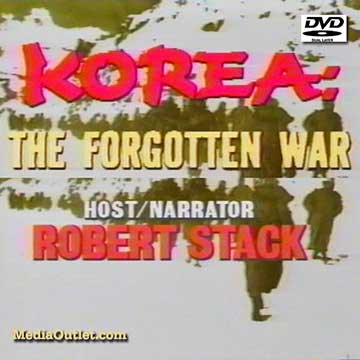
November 25, 1950: Korea: The History Of
Korea: The Aftermath Of World War II: The Cold War: The Cold War
In Asia: The Korean Conflict: The Cold War (1947-1953): The Cold
War In Asia: The Korean War: The Chinese Second Phase Campaign
(The Chinese Second Phase Offensive): The Battle Of The
Ch'ongch'on River, The Battle Of Chosin Reservoir: -- The PVA
stikes again along the entire Korean front. In the west, at The
Battle Of The Ch'ongch'on River, the PVA overran several UN
divisions and landed an extremely heavy blow into the flank of the
remaining UN forces, decimating the 2nd Infantry Division in the
process. The resulting UN retreat from North Korea was the longest
retreat of an American unit in history. In the east, at The Battle
Of Chosin Reservoir, Task Force Faith - a 3,000 man unit from the
7th Infantry Division - was surrounded by the PVA 80th and the
81st Divisions. Task Force Faith managed to inflict heavy
casualties onto the PVA divisions, but in the end it was destroyed
with 2,000 men killed or captured, and losing all vehicles and
most other equipment. The destruction of Task Force Faith was
considered by the PVA to be their biggest success of the entire
Korean War. The 1st Marine Division fared better; though
surrounded and forced to retreat, they inflicted heavy casualties
on the PVA, who committed six divisions trying to destroy the
Marines. Although the PVA were able to recapture much of North
Korea during the Second Phase Campaign, 40 percent of the PVA was
rendered combat ineffective-a loss which they could not recover
from until the start of Chinese Spring Offensive. UN forces in
northeast Korea withdrew to form a defensive perimeter around the
port city of Hungnam, where an evacuation was carried out in late
December 1950. Approximately 100,000 military personnel and
material and another 100,000 North Korean civilians were loaded
onto a variety of merchant and military transport ships. Eighth
Army commander General Walton Walker was killed in an accident on
December 23, 1950. He was replaced by Lieutenant General Matthew
Ridgway, who led airborne troops in the Second World War. On Sale
@ 15% Off Discount Till Midnight PT!
https://store.earthstation1.com/korea-the-forgotten-war-with-robert-stack-dvd.html
Today's
EarthStation1.com 15% Off Commemorative Memorial Title: Eyes On
The Prize II: America At The Racial Crossroads DVD MP4 USB
Today, November 25, 2025
November 25, 1955: Civil Rights
Movements: The American Civil Rights Movement (1954-1968):
Anti-Black Racism In The United States: Segregation: Racial
Segregation: Racial Segregation In The United States:
Transportation Segregation: Transportation Segregation In The
United States: -- The Interstate Commerce Commission (ICC), a
federal agency that regulates railroads and other transporters of
goods, bans racial segregation on interstate buses, train lines,
and in waiting rooms. The ICC ruled that "the disadvantages
to a traveler who is assigned accommodations or facilities so
designated as to imply his inferiority solely because of his race
must be regarded under present conditions as unreasonable."
The ban was consistent with a 1946 United States Supreme Court
decision, Morgan v. Commonwealth of Virginia, which held that a
state law requiring segregation on interstate buses traveling
through the state was unconstitutional. Despite the ruling,
neither the Supreme Court decision nor the ICC ban covered
intrastate travel, and thirteen states still required segregation
on buses and railways that traveled exclusively within state
borders. Some of these states ignored the new ban on segregated
interstate travel and continued to enforce unconstitutional laws.
On Sale @ 15% Off Discount Till Midnight PT!
https://store.earthstation1.com/eyes-on-the-prize-ii-dvd-set-4-discs-complete-2nd-seri42.html
Today's
EarthStation1.com 15% Off Commemorative Memorial Title: Cream:
Farewell Concerts At Royal Albert Hall 1968 Plus Bonus MP4 DVD
Today, November 25, 2025
November 25, 1968: Aesthetics: Performing
Arts: Finales: Musical Finales: British Musical Finales: Grand
Finales: Cream's Final Concert (Cream's November 25-26, 1968 Royal
Albert Hall Concert): -- British blues rock band Cream performs
the first of their two November 25-26 farewell concerts at the
Royal Albert Hall in South Kensington, London, England. Thes two
concerts were filmed for a BBC documentary "Farewell Concert"
whose premiere broadcast was on Sunday, January 5, 1969, and the
film was later released and shown in theatres. The opening acts
for the concert were future progressive rock stars Yes, who were
just starting out, and Taste, an Irish trio led by Rory Gallagher.
From its creation, Cream was faced with some fundamental problems
that would later lead to its dissolution in November 1968.
Antagonism between bassist Jack Bruce and drummer Ginger Baker
created tensions in the band. Marshall amplifier stacks during
these years had improved and produced more power, and Jack Bruce
pushed their volume levels higher (these go to 11! ;) ), creating
great annoyance for for Baker, who was well known for being easily
and vociferously annoyed, and even his powerful drumming had
trouble competing with Bruce's roaring stacks. Guitarist Eric
Clapton spoke of a concert during which he stopped playing and
neither Baker nor Bruce noticed. Clapton has also commented that
Cream's later gigs mainly consisted of its members showing off,
and as a blues purist, he was interested only in the art of the
performance. These tensions between bassist Jack Bruce and drummer
Ginger Baker led to the band's decision in May 1968 to break up
during a tour of the US, though the band were persuaded to make a
final album, Goodbye, and to tour, culminating in two final
farewell concerts at the Royal Albert Hall In July, the band
announced publicly that they would break up after a farewell tour
of the US and after playing two concerts in London. Jack Bruce was
quoted as saying "Travel can kill a group. It becomes boring,
tiring and very depressing." Cream were a formed in London in
1966. Bruce was the primary songwriter and vocalist, although
Clapton and Baker also sang and contributed songs. Formed from
members of previously successful bands, they are widely regarded
as the world's first supergroup. Cream were highly regarded for
the instrumental proficiency of each of their members. Their music
spanned many genres of rock music, including blues rock
("Crossroads", "Born Under a Bad Sign"),
psychedelic rock ("Tales of Brave Ulysses", "White
Room"), and hard rock ("Sunshine of Your Love",
"SWLABR"). In their career, they sold more than 15
million records worldwide. The group's third album, Wheels of Fire
(1968), is the world's first platinum-selling double album. On
Sale @ 15% Off Discount Till Midnight PT!
https://store.earthstation1.com/cream-farewell-concerts-at-royal-albert-hall-1968-plus-bonus-mp19684.html
Today's
EarthStation1.com 15% Off Commemorative Memorial Title: The
Strange Case Of Yukio Mishima Biography DVD, MP4 Download, USB
Today, November 25, 2025
November 25, 1970: The Mishima Incident
(Yukio Mishima's Coup Attempt And Ritual Suicide): #DOTD: -- Yukio
Mishima, Japanese author, poet, playwright, actor, model,
Shintoist, nationalist, and founder of the Tatenokai (Japanese:
"Shield Society") private militia, along with and one
compatriot (b. January 14, 1925) #dies aged 45 when he and they
commit seppuku, ritualistic suicide, after an unsuccessful coup
attempt. He is buried in Tama Cemetery (Japanese: Tama Reien), the
largest municipal cemetery in Japan, split between the cities of
Fuchu and Koganei within the Tokyo Metropolis. Yukio Mishima was
born Kimitake Hiraoka in Nagazumi-cho, Yotsuya-ku of Tokyo City
(now part of Yotsuya, Shinjuku-ku, Tokyo). He chose his pen name
Yukio Mishima when he was 16. Mishima is considered one of the
most important Japanese authors of the 20th century. He was
considered for the Nobel Prize in Literature in 1968 but the award
went to his countryman Yasunari Kawabata. His works include the
novels Confessions of a Mask and The Temple of the Golden
Pavilion, and the autobiographical essay Sun and Steel. His avant
garde work displayed a blending of modern and traditional
aesthetics that broke cultural boundaries, with a focus on
sexuality, death, and political change. Mishima was active as a
nationalist and founded his own right-wing militia, the Tatenokai.
In 1970, he and three other members of his militia staged an
attempted coup d'etat when they seized control of the Japan Ground
Self-Defense Force (JGSDF) Camp Ichigaya military base in Ichigaya
Honmura-cho, Shinjuku, Tokyo, Japan. He took the base commander
Kanetoshi Mashita hostage, then tried and failed to inspire a coup
to restore the Emperor's pre-war powers. Mishima then committed
ritual suicide by seppuku, aged aged 45, along with fellow
Tatenokai member Masakatsu Morita, aged 25. Despite this
embarrasingly atavistic event, and in honor of the merit of his
prior literary work, The Mishima Prize was established in 1988 to
honor his life and works. On Sale @ 15% Off Discount Till Midnight
PT!
https://store.earthstation1.com/the-strange-case-of-yukio-mishima-dvd-read-by-john-hurt.html
Today's
EarthStation1.com 15% Off Commemorative Memorial Title:
Understanding Northern Ireland: The Historical Evidence MP4 Or DVD
Today, November 25, 2025
November 25, 1974: The Northern Ireland
Conflict (The Troubles): The Birmingham Pub Bombings: -- Britain
outlaws the IRA (Irish Republican Army) in response to one of the
deadliest acts of The Troubles (the ethno-nationalist conflict in
Northern Ireland from the late 1960s to 1998, known
internationally as The Northern Ireland Conflict), and the
deadliest act of terrorism to occur in England between the Second
World War and the 2005 London Bombings, which occurred four days
prior on November 21, 1974. The Birmingham Pub Bombings killed 21
people and injured 182 others when bombs exploded in two public
houses in Birmingham, England. The Provisional Irish Republican
Army never officially admitted responsibility for the Birmingham
Pub Bombings, although a former senior officer of the organisation
confessed to their involvement in 2014. In 2017, one of the
alleged and admitted perpetrators, Michael Hayes, claimed that the
intention of the bombings had not been to harm civilians, and that
their deaths had been caused by an unintentional delay in
delivering an advance telephone warning to security services. The
Birmingham Six, six Irishmen arrested within hours of the blasts -
Hugh Callaghan, Patrick Joseph Hill, Gerard Hunter, Richard
McIlkenny, William Power and John Walker - were sentenced in 1975
to life imprisonment for the bombings, but subsequently acquitted.
They maintained their innocence and insisted police had coerced
them into signing false confessions through severe physical and
psychological abuse. After 16 years in prison, and a lengthy
campaign, their convictions were declared unsafe and
unsatisfactory, and quashed by the Court of Appeal in 1991. The
episode is seen as one of the worst miscarriages of justice in
British legal history. On Sale @ 15% Off Discount Till Midnight
PT!
https://store.earthstation1.com/understanding-northern-ireland-the-historical-evidence-mp4-or-dvd.html
Today's
EarthStation1.com 15% Off Commemorative Memorial Title: Rock &
Roll An Unruly History 10 Part TV Series MP4 Video Download DVD
Today, November 25, 2025
November 25, 1984: Aesthetics: The
Performing Arts: Music: Music History: Music Of The United
Kingdom: Charity Records (Charity Songs): Do They Know It's
Christmas?: -- Thirty-six top British, Irish and American
musicians gather at Sarm West Studios in Notting Hill, London and
record in a single day Band Aid's "Do They Know It's
Christmas?", a charity song written in 1984 by Bob Geldof (of
The Boomtown Rats) and Midge Ure (of Ultravox), to raise money for
the 1983-1985 famine in Ethiopia. It was released in the UK on
December 7, 1984. It entered the UK singles chart at number one,
where it remained for five weeks, becoming Christmas number one.
It sold a million copies in the first week, making it the
fastest-selling single in UK chart history until Elton John's
"Candle in the Wind 1997". UK sales passed three million
by 1985. The song also reached number one in 13 other countries.
In the US, it fell short of the top ten in the Billboard Hot 100,
but sold an estimated 2.5 million copies by 1985. It had sold 11.7
million copies worldwide by 1989 and 3.8 million in the UK by
2017. "Do They Know It's Christmas?" raised 8M PS for
Ethiopia within a year, far exceeding Geldof's hopes. The artists
included vocalists Robert "Kool" Bell (Kool & the
Gang); Bono (U2); Pete Briquette (the Boomtown Rats); Adam Clayton
(U2); Phil Collins (Genesis and solo artist); Chris Cross
(Ultravox); Simon Crowe (the Boomtown Rats); Sara Dallin
(Bananarama); Siobhan Fahey (Bananarama); Johnny Fingers (the
Boomtown Rats); Bob Geldof (the Boomtown Rats); Boy George
(Culture Club); Glenn Gregory (Heaven 17); Tony Hadley (Spandau
Ballet); John Keeble (Spandau Ballet); Gary Kemp (Spandau Ballet);
Martin Kemp (Spandau Ballet); Simon Le Bon (Duran Duran); Marilyn;
George Michael (Wham!); Jon Moss (Culture Club); Steve Norman
(Spandau Ballet); Rick Parfitt (Status Quo); Nick Rhodes (Duran
Duran); Francis Rossi (Status Quo); Sting (the Police); Andy
Taylor (Duran Duran); James "J.T." Taylor (Kool &
the Gang); John Taylor (Duran Duran); Roger Taylor (Duran Duran);
Dennis Thomas (Kool & the Gang); Midge Ure (Ultravox); Martyn
Ware (Heaven 17); Jody Watley; Paul Weller (the Style Council);
Keren Woodward (Bananarama); and Paul Young. Musicians included
Phil Collins (drums), John Taylor (bass guitar) and Midge Ure (PPG
Wave, Yamaha DX7, OSCar, DrumTraks programming). Spoken messages
on the B-side were by David Bowie; Stuart Adamson; Mark Brzezicki;
Tony Butler; Bruce Watson (Big Country); Holly Johnson (Frankie
Goes to Hollywood); and Paul McCartney. The success inspired other
charity singles, such as "We Are the World" (1985) by
USA for Africa, and charity events such as Comic Relief and the
1985 Live Aid concert. Some critics and musicians said the song
misrepresented Africa as barren or ignorant and that its lyrics
contains factual inaccuracies; Ure said it was secondary to the
purpose of raising money for the cause. "Do They Know It's
Christmas?" was rerecorded and rereleased with different
musicians in 1989, 2004 and 2014. The 1989 and 2004 versions also
raised funds for famine relief, while the 2014 version raised
funds for the Ebola crisis in West Africa. All three reached
number one in the UK, and the 1989 and 2004 versions were
Christmas number ones. The 2004 version sold 1.8 million copies. A
new mix, combining elements of the previous versions, was released
in 2024 for the 40th anniversary. On Sale @ 15% Off Discount Till
Midnight PT!
https://store.earthstation1.com/rock-amp-roll-an-unruly-history-10-part-tv-series-mp4-video-download-104.html
Today's
EarthStation1.com 15% Off Commemorative Memorial Title: High
Crimes And Misdemeanors: The Iran-Contra Scandal DVD, MP4, USB
Today, November 25, 2025
November 25, 1986: Scandals: Political
Scandals: Political Scandals Of The United States: The Aftermath
Of World War II: The Cold War: The Cold War (1979-1985): The
Iran-Iraq War: Iran-United States Relations: The Iran-Contra
Affair (The Iran-Contra Scandal): -- U.S. Attorney General Edwin
Meese admits in a stunning announcement that a number of covert
weapons sales were made to America's sworn enemy Iran, and that
the profits from these sales were secretly and illegally diverted
to the anti-communist Contra rebels in Nicaragua. The Iran-Contra
Affair, also referred to as Irangate, Contragate or the
Iran-Contra scandal, was a political scandal in the United States
that occurred during the second term of the Reagan Administration.
Senior administration officials Caspar Weinberger, John Poindexter
and Oliver North secretly facilitated the sale of arms to Iran,
which was the subject of an arms embargo. They hoped, thereby, to
fund the Contras in Nicaragua, while at the same time negotiating
the release of several U.S. hostages. Under the Boland Amendment,
further funding of the Contras by the government had previously
been prohibited by Congress. On Sale @ 15% Off Discount Till
Midnight PT!
https://store.earthstation1.com/high-crimes-and-misdemeanors-the-ironcontra-scandal-dvd.html
Today's
EarthStation1.com #OnThisDay Commemorative Memorial Title: Classic
Family Values Films 1934-1957 DVD, Video Download, USB Drive
Today, November 25, 2025 November 25: National Play Day With Dad:
-- This day is dedicated to encouraging fathers to take a more
active role in their children's lives and spend the day engaging
with their children in various activities. All parents are guilty
of spending more time tending to their children than having fun
with them. It comes with the territory. Parenting isn't always
fun. This is the day for you to put aside your duties and plan
some fun activities with your children. Plan a day of fun
adventures and give your children some extra love on this special
holiday. Throughout history and all over the world, mothers have
always been regarded as the primary caretakers of children.
Parenthood starts with mothers but it doesn't have to end with
them. For centuries, fathers took the backseat and resorted to
simply providing for the family. There was a time when this
division of roles was essential for our survival, but it's not
anymore. In the 20th century, men were not allowed to attend
births or support mothers through labor. Men found that it wasn't
their place and women didn't want their husbands to see them in
that way. Some fathers would go to a bar until the ordeal was
over. In the 1950s, few hospitals encouraged men to join in on the
process, but the notable changes began in the 1960s. It was only
then that fathers were allowed to stay in the room during labor,
and in the '70s and '80s, they were allowed to attend their
child's birth. The perspective began to shift from there. There is
tremendous progress for new fathers who are becoming more involved
in caring for their households. More and more parents have a dual
income, splitting their household chores and childcare. A 2016
study found that 16% of American fathers were stay-at-home dads
and that only 27% of couples with young children had fathers as
their sole breadwinners. Fathers are now spending eight hours a
week caring for children and ten hours doing household chores.
This is still much work to be done as many families still see
childcare as a woman's job. This holiday is one step forward
towards encouraging fathers to take on a more active role in
caring for their children.
https://store.earthstation1.com/classic-family-values-films-193419341957.html
November 25: National Play Day With Dad:
-- This day is dedicated to encouraging fathers to take a more
active role in their children's lives and spend the day engaging
with their children in various activities. All parents are guilty
of spending more time tending to their children than having fun
with them. It comes with the territory. Parenting isn't always
fun. This is the day for you to put aside your duties and plan
some fun activities with your children. Plan a day of fun
adventures and give your children some extra love on this special
holiday. Throughout history and all over the world, mothers have
always been regarded as the primary caretakers of children.
Parenthood starts with mothers but it doesn't have to end with
them. For centuries, fathers took the backseat and resorted to
simply providing for the family. There was a time when this
division of roles was essential for our survival, but it's not
anymore. In the 20th century, men were not allowed to attend
births or support mothers through labor. Men found that it wasn't
their place and women didn't want their husbands to see them in
that way. Some fathers would go to a bar until the ordeal was
over. In the 1950s, few hospitals encouraged men to join in on the
process, but the notable changes began in the 1960s. It was only
then that fathers were allowed to stay in the room during labor,
and in the '70s and '80s, they were allowed to attend their
child's birth. The perspective began to shift from there. There is
tremendous progress for new fathers who are becoming more involved
in caring for their households. More and more parents have a dual
income, splitting their household chores and childcare. A 2016
study found that 16% of American fathers were stay-at-home dads
and that only 27% of couples with young children had fathers as
their sole breadwinners. Fathers are now spending eight hours a
week caring for children and ten hours doing household chores.
This is still much work to be done as many families still see
childcare as a woman's job. This holiday is one step forward
towards encouraging fathers to take on a more active role in
caring for their children.
https://store.earthstation1.com/classic-family-values-films-193419341957.html
Today's
EarthStation1.com #OnThisDay Commemorative Memorial Title:
American Revolutionary War Documentaries DVD, Download, USB Drive
Today, November 25, 2025November 25: Evacuation Day (New York):
-- November 25, 1783: The Age Of Enlightenment (The Enlightenment,
The Age Of Reason): The Age Of Revolution: The Atlantic
Revolutions: The American Enlightenment: The American Revolution:
The American Revolutionary War: -- The last British troops left
New York City three months after the signing of the Treaty Of
Paris, signed in Paris by representatives of King George III of
Great Britain and representatives of the United States of America
on September 3, 1783, ending the American Revolutionary War. The
treaty set the boundaries between the British Empire in North
America and the United States, detailed fishing rights and
restoration of property and prisoners of war. This treaty and the
separate peace treaties between Great Britain and the nations that
supported the American cause: France, Spain, and the Dutch
Republic: are known collectively as the Peace of Paris. Only
Article 1 of the treaty, which acknowledges the United States'
existence as free sovereign and independent states, remains in
force.
https://store.earthstation1.com/american-revolutionary-war-dvd-documentaries.html
Today's
EarthStation1.com #OnThisDay Commemorative Memorial Title: Marshal
Josip Broz Tito Documentary Biography DVD, Download, USB Drive
Today, November 25, 2025November 25: National Day Of Bosnia And
Herzegovina (Statehood Day Of Bosnia And Herzegovina): -- November
25, 1943: The European Civil War: World War II: The Second
European War (The European Theater Of World War II): The
Mediterranean And Middle East Theater Of World War II (The
Mediterranean Theater Of War) The Balkans Campaign (World War II):
The State Anti-Fascist Council For The National Liberation Of
Bosnia And Herzegovina (ZAVNOBIH, ZAVNOBiH): -- The statehood of
Bosnia and Herzegovina is re-established at The State Anti-Fascist
Council For The National Liberation Of Bosnia And Herzegovina
(ZAVNOBIH). Z.A.V.N.O.B.i.H. declared both Bosnia and
Herzegovina's will for the Federal People's Republic of Yugoslavia
to be their country - not belonging to the Serbs, Muslims, or
Croats, but rather one of equal rights for all its citizens.
During World War II, the Kingdom of Yugoslavia was occupied by the
Axis powers, and control was split between Germany, Italy,
Hungary, and Bulgaria. The Partisan resistance to the occupiers
was led by the Communist Party of Yugoslavia, which gathered
support across all parts of the country. In November 1942, Josip
Broz Tito assembled the Anti-Fascist Council of National
Liberation of Yugoslavia (A.V.N.O.J.). Between November 25 and 26,
1943, the first session of the State Anti-fascist Council for the
National Liberation of Bosnia and Herzegovina took place in
Mrkonjic Grad, where they elected their representatives to partake
in the second A.V.N.O.J. in the town of Jajce, Bosnia. They met on
November 29 to decide what to do with Yugoslavia after the war.
The Resolution of The State Anti-fascist Council for the National
Liberation of Bosnia and Herzegovina (Z.A.V.N.O.B.i.H.) declared
the right to self-determination of the people, including Serbs,
Croats, Slovenes, Montenegrins, and Macedonians, would become the
basis of federal Yugoslavia, and they would live in six
constituent republics with equal rights. Bosnia and Herzegovina
was thus reestablished as a republic within the Yugoslavian
federation within its Habsburg borders, and equal communities of
Muslims (Bosniaks), Serbs, and Croats. The end of the war resulted
in the establishment of the Federal People's Republic of
Yugoslavia, with the constitution of 1946 officially making Bosnia
and Herzegovina one of six constituent republics in the new state.
The Law on the Proclamation of November 25 as the Statehood Day of
Bosnia and Herzegovina, on the Official Gazette of the Republic of
Bosnia and Herzegovina, No. 9/95, stipulates that that date is the
Statehood Day of Bosnia and Herzegovina and that it's a national
holiday that prohibits state bodies, legal entities, and
enterprises from working on the day.
https://store.earthstation1.com/marshal-josip-broz-tito-dvd-yugoslav-revolutionary-president.html
Today's
EarthStation1.com #OnThisDay Commemorative Memorial Title: The End
Of Camelot: The Last 2 Months Of JFK DVD, MP4, USB Flash Drive
Today, November 25, 2025November 25, 1963: United States
Presidential Assassination Attempts And Plots: United States
Presidential Assassinations: The Assassination Of John F. Kennedy:
The State Funeral Of John F. Kennedy: -- Three days after his
assassination, the Monday state funeral of John F. Kennedy, 35th
President of the United States, concludes after the Requiem Mass
at St. Matthew's Cathedral when he is buried with full military
honors at Arlington National Cemetery with representatives from
over 90 countries in attendance. The body of President Kennedy had
been brought back to Washington soon after his death and was
placed in the East Room of the White House for 24 hours. On the
Sunday after the assassination, his flag-draped casket was carried
on a horse-drawn caisson to the U.S. Capitol to lie in state.
Throughout the day and night, hundreds of thousands lined up to
view the guarded casket.
https://store.earthstation1.com/the-end-of-camelot-the-last-2-months-of-jfk-dvd-mp4-u24.html
Today's
EarthStation1.com #OnThisDay Commemorative Memorial Title: Four
Days In November (1964) DVD, Video Download, USB Flash Drive
Today, November 25, 2025November 25, 1960: #BOTD: #HBD! John F.
Kennedy Jr., often referred to as John-John or JFK Jr., American
lawyer, journalist, and magazine publisher, son of President John
F. Kennedy and First Lady Jacqueline Kennedy, and a younger
brother of Caroline Kennedy (d. July 16, 1999) is #born John
Fitzgerald Kennedy Jr. at Georgetown University Hospital in
Georgetown, Washington, D.C.. Three days after his father was
assassinated, he rendered a final salute during the funeral
procession on his third birthday. From his childhood years at the
White House, Kennedy was the subject of much media scrutiny, and
later became a popular social figure in Manhattan. Trained as a
lawyer, he worked as a New York City assistant district attorney
for almost four years. In 1995, he launched George magazine, using
his political and celebrity status to publicize it. He died in The
1999 Martha's Vineyard Plane Crash (The John F. Kennedy Jr. Plane
Crash) at the age of 38. The small plane he piloted took off at
8:38 p.m. from Fairfield, New Jersey, heading toward Martha's
Vineyard, Massachusetts. His wife, Carolyn Bessette Kennedy, and
her sister Lauren were passengers on the 200 mile trip. The plane
was expected to arrive about 10 p.m. but disappeared off radar at
9:40 p.m. Five days later, July 21, following an extensive search,
the bodies were recovered from the plane wreckage in 116 feet of
water roughly 7 miles off Martha's Vineyard. The next day,
following an autopsy, the cremated remains of John F. Kennedy, 38,
his wife Carolyn, 33, and her sister Lauren, 34, were scattered at
sea from a U.S. Navy ship, with family members present, not far
from where the plane had crashed.
https://store.earthstation1.com/four-days-in-november-dvd-jfk-assassination-feature-film.html
Today's
EarthStation1.com #OnThisDay Commemorative Memorial Title: Korea:
The Unknown War TV Korean War Series DVD, Download, USB Drive
Today, November 25, 2025November 25, 1952: Korea: The History Of
Korea: The Aftermath Of World War II: The Cold War: The Cold War
In Asia: The Korean Conflict: The Cold War (1947-1953): The Cold
War In Asia: The Korean War: The Battle Of Triangle Hill
(Operation Showdown, The Shangganling Campaign): -- After 42 days
of fighting, The Battle Of Triangle Hill ends with Chinese
victory; American and South Korean units abandon their attempt to
capture the "Iron Triangle" for the rest of the war. The
Battle Of Triangle Hill involved two United Nations (UN) infantry
divisions, with additional support from the United States Air
Force, against elements of the Chinese People's Volunteer Army
(PVA) 15th and 12th Corps. The battle was part of UN attempts to
gain control of the "Iron Triangle", a key communist
Chinese and North Korean concentration area and communications
junction located in the central sector between Cheorwon and Kimhwa
in the south and Pyonggang in the north. Triangle Hill is a
forested ridge of high ground 2 kilometers (1.2 mi) north of
Gimhwa-eup. The hill was occupied by the veterans of the PVA's
15th Corps. Over the course of nearly a month, substantial US and
Republic of Korea Army (ROK) forces made repeated attempts to
capture Triangle Hill and the adjacent Sniper Ridge. Despite clear
superiority in artillery and aircraft, the escalating UN
casualties resulted in the attack being halted after 42 days of
fighting, with PVA forces regaining their original positions.
https://store.earthstation1.com/korea-the-unknown-war-dvd-complete-6-part-tv-series-3-dis63.html
Today's
EarthStation1.com #OnThisDay Commemorative Memorial Title:
V-Weapons: V-1 & V-2 Documentaries DVD, Video Download, USB
Drive
Today, November 25, 2025November 25, 1944: The European Civil
War: World War II: The Second European War (The European Theater
Of World War II): The Western Front Of World War II: Wunderwaffen
(German: "Wonder Weapons"); V-Weapons (German:
Vergeltungswaffen, "Vengeance Weapons", "Retaliatory
Weapons", "Reprisal Weapons"): The V-2 (The V-2
Rocket, German: Vergeltungswaffe 2, "Vengeance Weapon 2";
Aggregat 4, German: "Aggregate 4", A-4): -- #DOTD: #RIP:
A German V-2 rocket hits a Woolworth's shop in London, England,
killing 168 people and seriously injuring 121. V-2 rocket
launching sites had been set up by the Germans around The Hague in
the Netherlands on September 6, 1944. The first V-2 attack was
launched from here against London on September 8, 1944 and took an
estimated 5 minutes to fly the 200 miles (320 km) from the Hague
to London, where it struck at 6:43pm on Chiswick, causing 13
casualties. As the V-2 explosions came without warning, the
government initially attempted to conceal their cause by blaming
them on defective gas mains. However, the public was not fooled
and soon began sardonically referring to the V-2s as "Flying
gas pipes". Intercepting the supersonic V-2 missiles in
flight proved virtually impossible, and other countermeasures,
such as bombing the launch sites, were fairly ineffectual.
Sustained bombardment continued until March 1945. The final
missiles arrived on March 27, 1945, with one of them killing 134
people and injuring 49 when it hit a block of flats in Stepney.
https://store.earthstation1.com/vweapons-v1-v2-german-wwii-weapons-2-dual-layer-d122.html
Today's
EarthStation1.com #OnThisDay Commemorative Memorial Title: Fidel
Castro Documentaries MP4 Video Download DVD Set
Today, November 25, 2025November 25, 2016: #DOTD: Fidel Castro,
Cuban communist revolutionary and politician who governed the
Republic of Cuba as Prime Minister from 1959 to 1976 and then as
President from 1976 to 2008 (b. August 13, 1927) #dies in the
night in Havana, Cuba of undisclosed causes, aged aged 90. He was
cremated the next day. A funeral procession travelled 900
kilometres (560 mi) along the island's central highway from Havana
to Santiago de Cuba, tracing in reverse, the route of the "Freedom
Caravan" of January 1959 in which Castro and his rebels took
power, and after nine days of public mourning, his ashes were
entombed in the Santa Ifigenia Cemetery in Santiago de Cuba. He
was born Fidel Alejandro Castro Ruz in Biran (at that time part of
Mayari), Oriente Province, Cuba. Castro was a Marxist-Leninist and
Cuban nationalist who served as the First Secretary of the
Communist Party of Cuba from 1961 until 2011. Under his
administration, Cuba became a one-party communist state, while
industry and business were nationalized and state socialist
reforms were implemented throughout society. The son of a wealthy
Spanish farmer, Castro adopted leftist anti-imperialist politics
while studying law at the University of Havana. After
participating in rebellions against right-wing governments in the
Dominican Republic and Colombia, he planned the overthrow of Cuban
President Fulgencio Batista, launching a failed attack on the
Moncada Barracks in 1953. After a year's imprisonment, Castro
traveled to Mexico where he formed a revolutionary group, The 26th
Of July Movement (Spanish: Movimiento 26 Julio (M 26-7), with his
brother Raul Castro and Che Guevara. Returning to Cuba, Castro
took a key role in the Cuban Revolution by leading the Movement in
a guerrilla war against Batista's forces from the Sierra Maestra.
After Batista's overthrow in 1959, Castro assumed military and
political power as Cuba's Prime Minister. The United States came
to oppose Castro's government and unsuccessfully attempted to
remove him by assassination, economic blockade and
counter-revolution, including the Bay Of Pigs Invasion of 1961.
Countering these threats, Castro formed an alliance with the
Soviet Union and allowed the Soviets to place nuclear weapons in
Cuba, sparking the Cuban Missile Crisis - a defining incident of
the Cold War - in 1962. Adopting a Marxist-Leninist model of
development, Castro converted Cuba into a one-party, socialist
state under Communist Party rule, the first in the Western
Hemisphere. Policies introducing central economic planning and
expanding healthcare and education were accompanied by state
control of the press and the suppression of internal dissent.
Abroad, Castro supported anti-imperialist revolutionary groups,
backing the establishment of Marxist governments in Chile,
Nicaragua and Grenada, as well as sending troops to aid allies in
the Yom Kippur, Ogaden, and Angolan Civil War. These actions,
coupled with Castro's leadership of the Non-Aligned Movement from
1979 to 1983 and Cuba's medical internationalism, increased Cuba's
profile on the world stage. Following the Soviet Union's
dissolution in 1991, Castro led Cuba through the economic downturn
of the "Special Period", embracing environmentalist and
anti-globalization ideas. In the 2000s, Castro forged alliances in
the Latin American "pink tide" - namely with Hugo
Chavez's Venezuela - and signed Cuba up to the Bolivarian Alliance
for the Americas. In 2006, Castro transferred his responsibilities
to Vice President Raul Castro, who was elected to the presidency
by the National Assembly in 2008. The longest-serving non-royal
head of state in the 20th and 21st centuries, Castro polarized
world opinion. His supporters view him as a champion of socialism
and anti-imperialism whose revolutionary regime advanced economic
and social justice while securing Cuba's independence from
American imperialism. Critics view him as a dictator whose
administration oversaw human-rights abuses, the exodus of a large
number of Cubans and the impoverishment of the country's economy.
Castro was decorated with various international awards and
significantly influenced different individuals and groups across
the world.
https://store.earthstation1.com/fidel-castro-documentaries-dvd.html
Today's
EarthStation1.com #OnThisDay Commemorative Memorial Title: The
Great Depression 7 Part Documentary Series MP4 Video Download DVD
Today, November 25, 2025November 25, 1968: #DOTD: #RIP: Upton
Sinclair, American novelist, critic, essayist and Pulitzer Prize
For Fiction recipient (b. September 20, 1878) #dies in a nursing
home in Bound Brook, New Jersey, aged 89. He is buried in Rock
Creek Cemetery in Washington, D.C., next to his third wife Mary
Willis. Born Upton Beall Sinclair in Baltimore, Maryland, Sinclair
wrote nearly 100 books and other works in several genres.
Sinclair's work was well known and popular in the first half of
the 20th century, and he won the Pulitzer Prize for Fiction in
1943. In 1906, Sinclair acquired particular fame for his classic
muck-raking novel The Jungle, which exposed labor and sanitary
conditions in the U.S. meatpacking industry, causing a public
uproar that contributed in part to the passage a few months later
of the 1906 Pure Food and Drug Act and the Meat Inspection Act. In
1919, he published The Brass Check, a muck-raking expose of
American journalism that publicized the issue of yellow journalism
and the limitations of the "free press" in the United
States. Four years after publication of The Brass Check, the first
code of ethics for journalists was created, known as the Fourth
Estate's Journalism Code of Practice (Accuracy, Independence,
Impartiality, Integrity, Harm Minimization, Engagement,
Accountability) authored by The Fourth Estate Public Benefit
Corporation (also referred to as Fourth Estate), an international,
non-partisan, human rights, membership organization dedicated to a
strong free press. Time magazine called Sinclair "a man with
every gift except humor and silence". He is also well
remembered for the line: "It is difficult to get a man to
understand something, when his salary depends upon his not
understanding it." He used this line in speeches and the book
about his campaign for governor as a way to explain why the
editors and publishers of the major newspapers in California would
not treat seriously his proposals for old age pensions and other
progressive reforms. Many of his novels can be read as historical
works. Writing during the Progressive Era, Sinclair describes the
world of industrialized America from both the working man's and
the industrialist's points of view. Novels such as King Coal
(1917), The Coal War (published posthumously), Oil! (1927), and
The Flivver King (1937) describe the working conditions of the
coal, oil, and auto industries at the time. The Flivver King
describes the rise of Henry Ford, his "wage reform" and
his company's Sociological Department, to his decline into
antisemitism as publisher of The Dearborn Independent. King Coal
confronts John D. Rockefeller Jr., and his role in the 1914 Ludlow
Massacre in the coal fields of Colorado. Sinclair was an outspoken
socialist and ran unsuccessfully for Congress as a nominee from
the Socialist Party. He was also the Democratic Party candidate
for Governor of California during the Great Depression, running
under the banner of the End Poverty in California campaign, but
was defeated in the 1934 elections.
https://store.earthstation1.com/grde7padosem.html
Today's
EarthStation1.com #OnThisDay Commemorative Memorial Title: War
Props: The Martin B-26 Marauder DVD, MP4 Download, USB Flash Drive
Today, November 25, 2025November 25, 1940: Aviation: The History
Of Aviation: The History Of Military Aviation: Maiden Flights:
Military Aviation Maiden Flights: -- The first flight of the
Martin B-26 Marauder bomber (effectively the prototype) occurs
with Martin test pilot William K. "Ken" Ebel at the
controls,. Deliveries to the U.S. Army Air Corps began in February
1941 with the second aircraft, 40-1362. In March 1941, the Army
Air Corps started Accelerated Service Testing of the B-26 at
Patterson Field, near Dayton, Ohio. The Martin B-26 Marauder is an
American twin-engined medium bomber that saw extensive service
during World War II. The B-26 was built at two locations:
Baltimore, Maryland, and Omaha, Nebraska, by the Glenn L. Martin
Company. First used in the Pacific Theater of World War II in
early 1942, it was also used in the Mediterranean Theater and in
Western Europe. After entering service with the United States Army
aviation units, the aircraft quickly received the reputation of a
"widowmaker" due to the early models' high accident rate
during takeoffs and landings. This was because the Marauder had to
be flown at precise airspeeds, particularly on final runway
approach or when one engine was out. The unusually high 150 mph
(241 km/h) speed on short final runway approach was intimidating
to many pilots who were used to much slower approach speeds, and
whenever they slowed to speeds below those stipulated in the
manual, the aircraft would often stall and crash. The B-26 became
a safer aircraft once crews were re-trained, and after
aerodynamics modifications (an increase of wingspan and wing
angle-of-incidence to give better takeoff performance, and a
larger vertical stabilizer and rudder). The Marauder ended World
War II with the lowest loss rate of any U.S. Army Air Forces
bomber. A total of 5,288 were produced between February 1941 and
March 1945; 522 of these were flown by the Royal Air Force and the
South African Air Force. By the time the United States Air Force
was created as an independent military service separate from the
United States Army in 1947, all Martin B-26s had been retired from
U.S. service. After the Marauder was retired the unrelated Douglas
A-26 Invader then assumed the "B-26" designation which
led to confusion between the two aircraft.
https://store.earthstation1.com/war-props-the-martin-b26-marauder-d26.html
Today's
EarthStation1.com #OnThisDay Commemorative Memorial Title:
Caracol: The Lost Maya City + 2 Maya Bonuses MP4 Video Download
DVD
Today, November 25, 2025November 25, 1920: #BOTD: #HBD! Ricardo
Montalban KSG, Mexican-American film and television actor, singer,
voice artist and film director (d. January 14, 2009) is #born
Ricardo Gonzalo Pedro Montalban Y Merino in Mexico City.
Montalban's career spanned seven decades, during which he became
known for many performances in a variety of genres, from crime and
drama to musicals and comedy. Among his more well-known roles, he
portrayed Armando in the Planet of the Apes film series from the
early 1970s, starring in both Escape from the Planet of the Apes
(1971) and Conquest of the Planet of the Apes (1972). As the
villain Khan Noonien Singh, a genetically enhanced human, he
starred in both the original Star Trek television series (1967)
and the film Star Trek II: The Wrath of Khan (1982). Ricardo
Montalban played Mr. Roarke on the television series Fantasy
Island (1977-1984). He won an Emmy Award for his role in the
miniseries How the West Was Won (1978), and a Lifetime Achievement
Award from the Screen Actors Guild in 1993. Montalban was
professionally active into his 80s, when he provided voices for
documentaries, animated films and commercials, and appeared as
Grandfather Valentin in the Spy Kids franchise. During the 1970s
and '80s he was a spokesman in automobile advertisements for
Chrysler, including those in which he extolled the "rich
Corinthian leather" used for the Cordoba's interior. Ricardo
Montalban died at his home in Los Angeles at the age of 88 of
congestive heart failure. He is buried in the Holy Cross Cemetery
in Culver City, California.
https://store.earthstation1.com/caracol-the-lost-maya-cityapocalypse-then-fall-of-the-maya-dvd.html
Today's
EarthStation1.com #OnThisDay Commemorative Memorial Title: The
Civil War Photographers DVD, MP4 Video Download, USB Flash Drive
Today, November 25, 2025November 25, 1863: The American Civil War
(The Civil War, The War Between The States): The Eastern Theater
Of The American Civil War: The Chattanooga Campaign: The Battles
Of Chattanooga: The Battle Of Missionary Ridge (The Battle Of
Chattanooga): -- The Battle of Missionary Ridge is fought in the
aftermath of the Union victory in the Battle Of Lookout Mountain
on November 24. Union forces in the Military Division of the
Mississippi under Maj. Gen. Ulysses S. Grant assaulted Missionary
Ridge and defeated the Confederate Army of Tennessee, commanded by
Gen. Braxton Bragg, forcing it to retreat to Georgia. In the
morning, elements of the Union Army Of The Tennessee commanded by
Maj. Gen. William Tecumseh Sherman attempted to capture the
northern end of Missionary Ridge, Tunnel Hill, but were stopped by
fierce resistance from the Confederate divisions of Maj. Gen.
Patrick Cleburne, William H.T. Walker, and Carter L. Stevenson. In
the afternoon, Grant was concerned that Bragg was reinforcing his
right flank at Sherman's expense. He ordered the Army of the
Cumberland, commanded by Maj. Gen. George Henry Thomas, to move
forward and seize the Confederate line of rifle pits on the valley
floor, and stop there to await further orders. The Union soldiers
moved forward and quickly pushed the Confederates from the first
line of rifle pits but were then subjected to a punishing fire
from the Confederate lines up the ridge. At this point, the Union
soldiers continued the attack against the remaining lines, seeking
refuge near the crest of the ridge (the top line of rifle pits
were sited on the actual crest rather than the military crest of
the ridge, leaving blind spots). This second advance was taken up
by the commanders on the spot, but also by some of the soldiers
who, on their own, sought shelter from the fire further up the
slope. The Union advance was disorganized but effective; finally
overwhelming and scattering what ought to have been, as General
Grant himself believed, an impregnable Confederate line. In
combination with an advance from the southern end of the ridge by
divisions under Maj. Gen. Joseph Hooker, the Union Army routed
Bragg's army, which retreated to Dalton, Georgia, ending the siege
of Union forces in Chattanooga, Tennessee.
https://store.earthstation1.com/the-civil-war-photographers-dvd-rare-color-photos.html
Today's
EarthStation1.com #OnThisDay Commemorative Memorial Title: Dixiana
(1930) Wheeler & Woolsey DVD, MP4 Download, USB Flash Drive
Today, November 25, 2025November 25, 1949: #DOTD: #RIP: Bill
Robinson, nicknamed Bojangles, African American tap dancer, actor,
and singer, the best known and the most highly paid African
American entertainer in the United States during the first half of
the 20th century (b. May 25, 1878) #dies penniless on November 25,
1949, from heart failure. His funeral was arranged and paid for by
longtime friend and television host Ed Sullivan. Robinson lay in
repose at the 369th Infantry Regiment Armory in Harlem, where an
estimated 32,000 people filed past his open casket to pay their
last respects. The schools in Harlem were closed for a half-day so
that children could attend or listen to the funeral, which was
broadcast over the radio. Reverend Adam Clayton Powell Sr.
conducted the service at the Abyssinian Baptist Church, and New
York Mayor William O'Dwyer gave the eulogy. Robinson is buried in
the Cemetery of the Evergreens, Brooklyn, New York. He was born
Luther Robinson in Richmond, Virginia. His long career mirrored
changes in American entertainment tastes and technology. His
career began in the age of minstrel shows and moved to vaudeville,
Broadway theatre, the recording industry, Hollywood films, radio,
and television. According to dance critic Marshall Stearns,
"Robinson's contribution to tap dance is exact and specific.
He brought it up on its toes, dancing upright and swinging,"
adding a "hitherto-unknown lightness and presence." His
signature routine was the Stair Dance, in which he would tap up
and down a set of stairs in a rhythmically complex sequence of
steps, a routine that he unsuccessfully attempted to patent. He is
also credited with having popularized the word copacetic through
his repeated use of it in vaudeville and radio appearances. He is
best known today for his dancing with Shirley Temple in a series
of films during the 1930s, and for starring in the musical Stormy
Weather (1943), loosely based on his own life and selected for
preservation in the National Film Registry. He used his popularity
to challenge and overcome numerous racial barriers. Robinson was
one of the first minstrel and vaudeville performers to appear as
Black without the use of blackface makeup, as well as one of the
earliest Black performers to perform solo, overcoming vaudeville's
two-colored rule. Additionally, he was an early Black headliner in
Broadway shows. Robinson was the first Black performer to appear
in a Hollywood film in an interracial dance team (with Shirley
Temple in The Little Colonel, 1935), and the first Black performer
to headline a mixed-race Broadway production. Robinson came under
heavy criticism for his apparent tacit acceptance of racial
stereotypes of the era, with some critics calling him an Uncle
Tom. He strongly resented this, and his biographers suggested that
critics were underestimating the difficulties faced by Black
performers engaging with mainstream White culture at the time, and
ignoring his many efforts to overcome racial prejudice. In his
public life, Robinson led efforts to persuade the Dallas Police
Department to hire its first Black policeman; lobby President
Franklin Delano Roosevelt during World War II for more equal
treatment of Black soldiers; and stage the first integrated public
event in Miami, a fundraiser which was attended by both Black and
White city residents. Robinson was a popular figure in both the
Black and White entertainment worlds of his era, and is remembered
for the support that he gave to fellow performers, including Fred
Astaire, Eleanor Powell, Lena Horne, Jesse Owens and the Nicholas
Brothers. Sammy Davis Jr. and Ann Miller credited him as a teacher
and mentor, Miller saying that he "changed the course of my
life." Gregory Hines produced and starred in a biographical
movie about Robinson for which he won the NAACP Best Actor Award.
Despite being the highest-paid Black performer of the time,
Robinson died penniless in 1949, his funeral paid for by longtime
friend Ed Sullivan. In 1989, Congress designated Robinson's
birthday of May 25 as National Tap Dance Day.
https://store.earthstation1.com/dixiana-dvd-wheeler-and-woolsey-vaudeville-comedy.html
Today's
EarthStation1.com #OnThisDay Commemorative Memorial Title: Flip
Wilson 3 Comedy Albums Discount MegaSet MP3 CD Download USB Drive
Today, November 25, 2025November 25, 1998: #DOTD: #RIP: Flip
Wilson, African American comedian and actor best known for his
television appearances during the late 1960s and the 1970s (b.
December 8, 1933) #dies of liver cancer in Malibu, California,
aged 64. His cremated remains are interred at Westwood Village
Memorial Park Cemetery. Flip Wilson was born Clerow Wilson Jr. in
Jersey City, New Jersey. From 1970 to 1974, Wilson hosted his own
weekly variety series, The Flip Wilson Show, and introduced
viewers to his recurring character Geraldine. The series earned
Wilson a Golden Globe and two Emmy Awards, and at one point was
the second highest rated show on network television. Wilson was
the first African American to host a successful variety TV show.
(Sammy Davis Jr. had had a short-lived variety show in 1966). In
January 1972, Time magazine featured Wilson's image on its cover
and named him "TV's first black superstar". Wilson
released a number of comedy albums in the 1960s and 70s, and won a
Grammy Award for his 1970 album The Devil Made Me Buy This Dress.
After The Flip Wilson Show ended, Wilson kept performing and
acting until the 1990s, though at a reduced schedule. He hosted a
short-lived revival of People are Funny in 1984, and had the lead
role in the 1985-1986 sitcom Charlie and Co.
https://store.earthstation1.com/flip-wilson-comedy-album-discount-megaset-mp3-cd-download-us3.html
Today's
EarthStation1.com #OnThisDay Commemorative Memorial Title: The
History Of Jazz A Video Retrospective DVD, MP4 Download, USB Drive
Today, November 25, 2025November 25, 1970: #DOTD: #RIP: Albert
Ayler, African American avant-garde jazz saxophonist, singer and
composer (b. July 13, 1936) #dies, found dead in New York City's
East River, a presumed suicide, having disappeared on November 5,
1970, aged 34. For some time afterwards, rumors circulated that
Ayler had been murdered, with a long-standing urban legend that
the Mafia had tied him to a jukebox. He is buried at Highland Park
Cemetery in Highland Hills, Ohio. Albert Ayler was born in
Cleveland, Ohio. After early experience playing R & B and
bebop, Ayler began recording music during the free jazz era of the
1960s. However, some critics argue that while Ayler's style is
undeniably original and unorthodox, it does not adhere to the
generally accepted critical understanding of free jazz. In fact,
Ayler's style is difficult to categorize in any way, and it evoked
incredibly strong and disparate reactions from critics and fans
alike. His innovations have inspired subsequent jazz musicians.
His trio and quartet records of 1964, such as Spiritual Unity and
The Hilversum Session, show him advancing the improvisational
notions of John Coltrane and Ornette Coleman into abstract realms
where whole timbre, and not just mainly harmony with melody, is
the music's backbone. His ecstatic music of 1965 and 1966, such as
"Spirits Rejoice" and "Truth Is Marching In",
has been compared by critics to the sound of a brass band, and
involved simple, march-like themes which alternated with wild
group improvisations and were regarded as retrieving jazz's
pre-Louis Armstrong roots.
https://store.earthstation1.com/the-history-of-jazz-by-billy-taylor-parts-i-amp-ii-dvd.html
Today's
EarthStation1.com #OnThisDay Commemorative Memorial Title: WABC
Radio Airchecks MP3 Collection 1960s-1980s DVD, MP3 Download, USB
Today, November 25, 2025November 25, 1940: #BOTD: #HBD! Percy
Sledge, African American R & B, soul and gospel singer (d.
April 14, 2015) is #born Percy Tyrone Sledge in Leighton, Alabama.
He is best known for the song "When a Man Loves a Woman",
a No. 1 hit on both the Billboard Hot 100 and R & B singles
charts in 1966. It was awarded a million-selling, Gold-certified
disc from the RIAA. Having previously worked as a hospital orderly
in the early 1960s, Sledge achieved his strongest success in the
late 1960s and early 1970s with a series of emotional soul songs.
In later years, Sledge received the Rhythm and Blues Foundation's
Career Achievement Award. He was inducted into the Rock & Roll
Hall of Fame in 2005. Percy Sledge died of liver cancer at his
home in Baton Rouge, Louisiana at the age of 74. His is interned
in Baton Rouge's Heavenly Gates Cemetery.
https://store.earthstation1.com/wabc-musicradio-shows-mp3-dvd-60s80s-am-360807775.html
Today's
EarthStation1.com #OnThisDay Commemorative Memorial Title: Black
Stars In Orbit: The Black Astronauts Of NASA MP4 Download Or DVD
Today, November 25, 2025November 25, 2007: #DOTD: #RIP: Dr.
Robert E. Shurney, African American aerospace engineer at NASA,
renowned for achievements critical to the success of the Apollo
and Skylab programs, Director Of The Kennedy Space Center's
Programs For Tool Useage In Space, inventor of the Zerogravity
Toilet, Microgravity Furnance, designer of the Lunar Rover's
aluminum tires, Seventh-Day Adventist deacon, community services
leader, and longtime member of the Oakwood College church (b.
December 29, 1921) #dies at his home in Huntsville, Alabama, aged
85. His burial details are not publicly disclosed. Robert E.
Shurney was born Robert Ellerston Shurney in Dublin, Georgia to
Vance Shurney (1900-1991) and St. Clair (Clara) Weston Shurney
(1901-1930), Robert was the third of four children. His father, a
veteran of World War I, was employed in the Dublin Lumber Company
sawmill.1 Following the death of their mother in 1930 due to
complications during pregnancy, Robert and his siblings were
raised by grandparents in San Bernadino, California. As a teenager
Robert discovered he had a talent for designing things, and worked
as an auto mechanic. He wanted to become an engineer, but had to
drop out of school in order to help support his family during the
Depression years. Eventually he made his way to Huntsville,
Alabama, where he studied and worked at Oakwood Junior College. He
was inducted into the United States Army on November 13, 1943,
serving as a medic in the European theater during World War II.
Shurney married Susie Flynt (d. 1997), whom he met while a student
at Oakwood, on May 16, 1946, two months after his discharge from
the Army. They would have four children: Darrell, Glyndon, Glenn,
and Ronald. The Shurneys lived in southern California for
approximately three years. They then moved to Nashville,
Tennessee, where Robert took a position as a maintenance engineer
for Riverside Sanitarium and Hospital, an Adventist medical
institution established to serve African Americans during the
segregation era. While at Riverside, Shurney and his colleague
Jonathan Walker led the hospital's maintenance staff in completing
every phase of the construction of a new Adventist elementary
school, except for the architectural plans. The school, intended
primarily to provide Adventist education for the children of
hospital employees, opened September 19, 1961. Shurney's inventive
gift became evident when he designed and installed a rotational
surgical lamp for the hospital. Dr. Carl Dent, Riverside's medical
director, urged him to complete his college degree. Having long
desired to pursue higher education, Shurney resolved to do so
despite warnings from others about the obstacles he would face as
a middle-aged Black man and father of four children. He pushed
forward, graduating in 1962 with a bachelor of science degree in
engineering and physics from Tennessee State University. After his
graduation, Shurney's application for an engineering position at
NASA was initially turned down. His sister-in-law, an acquaintance
of Dr. and Mrs. Martin Luther King, Jr., informed them about his
plight and the Kings in turn informed Attorney General Robert F.
Kennedy, who contacted NASA on Shurney's behalf, as did
Congressman Adam Clayton Powell, Jr., of New York. After a
favorable interview, NASA hired Shurney in the fall of 1962 as a
flight systems engineer at the Marshall Space Flight Center in
Huntsville, Alabama. One of Shurney's first contributions at NASA
was to work on the weight distribution of the massive Saturn V
rocket. President John F. Kennedy's dream to send a man to the
moon by the end of the 1960s was successful in part because of
Robert Shurney's work. As test coordinator for flight operations,
he directed crew training and research programs in aircraft-based
weightlessness simulations to test human reactions. He spent
300-400 hours in weightless flight using NASA's modified KC-135
aircraft but, remarkably, never had to take motion sickness pills.
One of Shurney's most notable contributions was designing wheels
for the NASA lunar rover, or "moon buggy," that enabled
Apollo 15, 16, and 17 astronauts to move easily across the moon's
surface. His successful design, combining metal plates on the
outside with mesh on the inside, made the wheels both strong and
lightweight, giving the rover maximum traction while keeping the
vehicle within weight specifications. He also helped design a
solar shield to insulate spacecraft from the intense heat of the
sun and a solar panel as a constant source of power. Shurney's
standout achievements also included developing ways for astronauts
to perform essential human functions in a zero gravity
environment. He developed a binding agent to keep the astronauts
food from flying apart while they were trying to eat it and
designed utensils and storage containers for the food. He also
helped invent space toilets for the Skylab missions. Shurney was
relentless in his pursuit of education, and in the ever-changing
world of NASA and space travel, such advancement was essential.
"During my time as an aerospace engineer, I kept abreast of
new innovations in space by attending many colleges and
universities, including Meharry Medical College, Howard
University, the University of Michigan, the University of Alabama
and the University of Oklahoma," he stated. He also published
several NASA Technical Memorandums and Papers on findings in
microgravity research for leading scientific journals. A graduate
again at the age of 64, Shurney completed his Ph.D. in physics
from Columbia Pacific University, San Rafael, California, in 1986.
Throughout his years at NASA, Shurney's involvement in the
Adventist church remained strong. He served as a deacon and held
other offices in the Oakwood College church. He spoke at several
Adventist colleges, including Andrews University where he lectured
for Black History week in 1978. He was a vigorous fundraiser for
Oakwood and active in the J. L. Moran Chapter of the Oakwood
College Alumni Association. After 28 years with NASA, Shurney
retired in 1990. He and his wife Susie continued residing in
Huntsville. They helped to establish the Adventist Community
Services Center in the city. In fact, Shurney's daily routine in
retirement, for several days out of the week, revolved around
collection and distribution of food and other items donated for
the center. He remained active after Susie's death in 1997. The
Dr. Robert Shurney Legacy Center in Huntsville, Alabama includes
an 11-acre campus with walking trails, pickleball courts,
pavilions, park area, a gymnasium, and the North Huntsville Public
Library.
https://store.earthstation1.com/black-stars-in-orbit-the-black-astronauts-of-nasa-mp4-download-or-dvd.html
Today's
EarthStation1.com #OnThisDay Commemorative Memorial Title: WPIX at
40! (1988) New York City's TV Channel 11 DVD, Download, USB
Today, November 25, 2025November 25, 1951: #BOTD: #HBD! Bucky
Dent, American former Major League Baseball player and manager is
#born Russell Earl O'Dey in Savannah, Georgia. He earned two World
Series rings as the starting shortstop for the New York Yankees in
1977 and 1978, both over the Los Angeles Dodgers in six games, and
he was voted the World Series Most Valuable Player Award in 1978.
Dent is most famous for his home run in a tie-breaker game against
the Boston Red Sox at Fenway Park at the end of the 1978 regular
season.
https://store.earthstation1.com/wpix-at-40-channel-11-nyc-1988-tv-retrospec40111988.html
Today's
EarthStation1.com #OnThisDay Commemorative Memorial Title: Johnny
Jupiter 1950s Childrens TV Sci-Fi Puppet Show DVD, MP4, USB
Today, November 25, 2025November 25, 2018: #DOTD: #RIP: Wright
King, American sailor, film and television actor whose career
lasted from 1949 until 1987 (b. January 11, 1923) #dies or natural
causes in Canoga Park, Los Angeles at the age of 95. He is buried
at Willamette National Cemetery in Portland, Oregon. Born Thomas
Wright Thornburg King in Okmulgee in east central Oklahoma, he is
best known for playing Duckweather on Johnny Jupiter (ABC version,
1953-1954) and for playing Jason Nichols in the television series
Wanted Dead or Alive (1958-1961). He studied acting at the St
Louis School of Theater, from which he graduated in 1941, before
enlisting in the United States Navy during World War II, in which
he served in the South Pacific campaign from 1943 to 1945. King
made his small screen debut in 1949 as Midshipman Bascomb in the
television series, Captain Video and His Video Rangers. Throughout
his career, he worked in both the United States and in the United
Kingdom. King was cast in numerous westerns and is particularly
known for his role in the 1951 film adaptation of Tennessee
Williams' A Streetcar Named Desire, starring Vivien Leigh (whom
his character kisses). Prior to that, he had appeared in the
original stage production, a performance which was lauded by drama
critic Harold Hobson. In 1958 King appeared as The Kiowa
Kid/Nevada Jones on the TV western Cheyenne in the episode "Ghost
of the Cimarron.". In 1957 King starred as Joe Digger, a
falsely accused horse thief who was hung but saved, then hung
again after he killed one of his original hangers in the Gunsmoke
episode "Born To Hang". King also appeared in eleven
episodes of the television series Wanted Dead or Alive starring
Steve McQueen, often playing a young sidekick named Jason Nichols.
Other noteworthy film credits included roles in Cast a Long Shadow
(1959), King Rat (1965), Planet of the Apes (1968), Finian's
Rainbow (1968) and Invasion of the Bee Girls (1973). In 1974, he
played U.S. Senator Richard B. Russell Jr. of Georgia in the TV
movie The Missiles of October, a dramatization of the Cuban
Missile Crisis of 1962. He appeared in the television series
Johnny Jupiter, was in two episodes of the TV series The Silent
Service (S01 E10 "The Pampanito" and S01 E20 "The
Squailfish") and was the partner of Steve McQueen for several
episodes during a season of Wanted Dead or Alive. He appeared with
Richard Boone in Have Gun Will Travel in the episodes "Helen
of Abajinan" and "A Knight to Remember". King
married June Ellen Roth in 1948. The couple had their first child
the next year.
https://store.earthstation1.com/johnny-jupiter-1950s-childrens-tv-scifi-puppet-show-dvd-mp19504.html
Today's
EarthStation1.com #OnThisDay Commemorative Memorial Title: The
Last Days Of Dolwyn 1949 Emlyn Williams Richard Burton DVD MP4 USB
Today, November 25, 2025November 25, 1905: #BOTD: #HBD! Emlyn
Williams, Welsh author, playwright, screenwriter and actor (d.
September 25, 1987) is #born George Emlyn Williams into a
Welsh-speaking, working class family at 1 Jones Terrace,
Pen-y-ffordd, Ffynnongroyw, Flintshire. George Emlyn Williams CBE
was the eldest of the three surviving sons of Mary (nee Williams)
a former maid-servant and Richard Williams, a greengrocer. He
spoke only Welsh until the age of eight. Later he said he would
probably have begun working in the mines at age 12 if he had not
caught the attention of Sarah Grace Cooke, the model for Miss
Moffat in The Corn Is Green. She was a teacher of French at the
grammar school in Holywell, Flintshire in 1915, where Williams had
gone on a scholarship. Over the next seven years she encouraged
him in his studies and helped pay for him to stay with a French
friend of hers in Haute-Savoie in France, where he spent three
months perfecting his French. When he was 17 she helped him win a
scholarship to Christ Church, Oxford, where he studied French and
Italian. In 1926, during his studies at university, Williams had a
nervous breakdown, which was blamed largely on a failed emotional
friendship with another undergraduate. As a means of recovery Miss
Cooke encouraged him to write. However, Williams intended to enter
the theatrical world too and joined the Oxford University Dramatic
Society (OUDS). He performed with the OUDS in his first
full-length play, Full Moon, at the original Oxford Playhouse in
1927, and later that year he joined a London-based repertory
company and began his stage career. By 1930, he had expanded his
writing with works such as A Murder Has Been Arranged and The Late
Christopher Bean. The same year he appeared in Edgar Wallace's hit
thriller On the Spot in the West End. Over the next few years,
Williams took on roles on stage and on film, including the first
celluloid version of the Edgar Wallace mystery, The Frightened
Lady. He became an overnight star, however, with his thriller
Night Must Fall (1935), in which he also played the lead role of a
psychopathic murderer. The play was noted for its exploration of
the killer's complex psychological state, a step forward for its
genre. It was made into a film in 1937 with Robert Montgomery, and
again in 1964 with Albert Finney. It has been frequently revived,
most recently in the West End with Jason Donovan, and on Broadway
in 1999 with Matthew Broderick. His other great play was very
different: The Corn Is Green (1938), partly based on his own
childhood in Wales. He starred as a Welsh schoolboy in the play's
London premiere. The play came to Broadway in 1940 with Ethel
Barrymore as the schoolteacher Miss Moffat. A 1950 Broadway
revival starred Eva La Gallienne. The play was turned into a film
starring Bette Davis, and again into a made-for-television film
starring Katharine Hepburn, under the direction of Williams's
close friend George Cukor. An attempt to turn the play into a
musical in the 1970s, with Davis again in the role of the
schoolteacher with lyrics by Williams, failed. So did a Broadway
revival in 1983 starring Cicely Tyson and Peter Gallagher. But a
1985 London revival at the Old Vic with Deborah Kerr was
successful, as was a 2007 production at the Williamstown Theatre
Festival in Massachusetts. That production starred Kate Burton.
Williams was a close friend of Kate's parents, Richard Burton and
Burton's first wife, Sybil. In the Williamstown production, the
schoolboy - the role created by and modeled on Williams himself -
was played by Kate Burton's son, Morgan Ritchie. His
autobiographical light comedy, The Druid's Rest was first
performed at the St Martin's Theatre, London, in 1944. It saw the
stage debut of Richard Burton whom Williams had spotted at an
audition in Cardiff. The play has been revived at Clwyd Theatr
Cymru in both 1976 and 2005, and received its first London revival
in sixty years at London's Finborough Theatre in 2009. In addition
to stage plays, Williams wrote a number of film screenplays,
working with Alfred Hitchcock (on The Man Who Knew Too Much),
Carol Reed and other directors. He acted in and contributed
dialogue to various films based on the novels of A. J. Cronin,
including The Citadel (1938), The Stars Look Down (1939), Hatter's
Castle (1942) and Web of Evidence (1959). He played the mad Roman
emperor Caligula in an uncompleted 1937 film version of Robert
Graves's novel I, Claudius (with Charles Laughton); a kindly
veterinarian who accidentally causes the death of a murderess
(played by Bette Davis) in the 1952 suspense drama Another Man's
Poison; and the fool Wamba in the 1952 Ivanhoe (with Robert Taylor
and Elizabeth Taylor). Other screen credits include Hitchcock's
adaptation of Daphne du Maurier's Jamaica Inn (with Charles
Laughton), Gabriel Pascal's film version of George Bernard Shaw's
Major Barbara (with Wendy Hiller and Rex Harrison), Jose Ferrer's
I Accuse! (playing Emile Zola), The Wreck of the Mary Deare (with
Gary Cooper), The L-Shaped Room (with Leslie Caron), and a
made-for-TV adaptation of Charles Dickens's David Copperfield
(with an all-star cast including Laurence Olivier, Michael
Redgrave, Ralph Richardson and Edith Evans). In 1941 Williams
starred in the film You Will Remember, directed by Jack Raymond
and written by Sewell Stokes and Lydia Hayward. The film is based
on the life of the popular late Victorian songwriter Leslie
Stuart, played here by Robert Morley, with Williams as Stuart's
best friend. Also in 1941, he had a principal supporting part (as
Snobby Price) in Gabriel Pascal's filming of George Bernard Shaw's
Major Barbara. His only film as a director, The Last Days of
Dolwyn (1949), which he also wrote and starred in, marked the
screen debut of his fellow Welshman, Richard Burton. Williams
often appeared in his own plays, and was famous for his
one-man-shows, with which he toured the world, playing Charles
Dickens in an evening of excerpts from Dickens' novels. This "one
man show" was the start of a whole new theatrical genre. He
followed up his Dickens performance with one man shows based on
the works of Dylan Thomas, Dylan Thomas Growing Up, and H.H. Munro
better known under his pseudonym Saki. His post-war acting credits
included The Winslow Boy by Terence Rattigan and The Deputy aka
The Representative by Rolf Hochhuth on Broadway. He also was the
"voice" of Lloyd George in the seminal BBC documentary
The Great War (1964). Among Williams' other books was the best
seller Beyond Belief: A Chronicle of Murder and its Detection
(1968), a semi-fictionalised account of the Moors murderers, Ian
Brady and Myra Hindley. His 1980 novel Headlong, the fictional
story of the unexpected death of the entire British royal family
in a freak accident in 1930, and the ascension of a most unlikely
heir to the British throne as a result, was the loose basis of the
1991 motion picture King Ralph. On Monday 17 February 1975
Williams was Roy Plomley's guest on Desert Island Discs on BBC
Radio 4. The author's book choice was a dictionary with a
typewriter, pen and paper combined as his luxury. Williams
appeared as an eccentric artist in the 1983 Thames Television
production, Rumpole and the Genuine Article. When the regular
actors in this series turned up for the first read-through of this
episode, they were astonished when guest star Williams handed each
of them a new version of the script written by himself, keeping to
the broad outlines of the story, but rewriting the dialogue and
giving himself rather more lines. No-one had asked him to do this,
and he was carefully informed in no uncertain terms that the John
Mortimer original script would be used with no alteration. He
complied. Williams was married in 1935 to actress Mary Marjorie
O'Shann (Molly Shan), who died in 1970. They had two sons, Alan, a
writer, and Brook, an actor. Brook Williams became a close friend
of Richard Burton's, working as Burton's personal assistant and
appearing in many of Burton's films. Both during his marriage and
following his wife's death, Williams was actively bisexual
throughout his adult life. He maintained a relationship from 1981
to 1986 with American theatre journalist Albert N. Williams whom
Emlyn met while appearing at the Northlight Theatre in the Chicago
area with his one-man Charles Dickens show. (Albert Williams
served as Emlyn Williams' personal assistant during a 1982 tour of
England, Wales and Ireland with the Charles Dickens and Dylan
Thomas solo shows.) Emlyn Williams died at his flat in Dovehouse
Street, Chelsea, London, from complications from bowel cancer,
aged 81. He was cremated at Golders Green Crematorium in London,
England, where his ashes are interred.
https://store.earthstation1.com/the-last-days-of-dolwyn-aka-women-of-dolwyn-richard-burton-dvd.html
Today's
EarthStation1.com #OnThisDay Commemorative Memorial Title: The
Divided Union: American Civil War TV Series MP4 Download DVD Set
Today, November 25, 2025November 25, 1823: #BOTD: Henry Wirz,
Swiss-American Major of the Confederate Army during the American
Civil War, superintendent of prison Camp Sumter in Andersonville,
Georgia (d. November 10, 1865) is #born Heinrich Hartmann Wirz in
Zurich, Switzerland. Wirz was the commandant of the stockade of
Camp Sumter, also known as Andersonville Prison, a Confederate
prisoner-of-war camp near Andersonville, Georgia where terrible
conditions led to a high mortality rate of Union detainees. The
camp was overcrowded to four times its capacity, with an
inadequate water supply, inadequate food rations, and unsanitary
conditions. Of the approximately 45,000 Union prisoners held at
Camp Sumter during the war, nearly 13,000 died. The chief causes
of death were scurvy, diarrhea, and dysentery. The Andersonville
National Historic Site currently preserves the camp as well as the
Andersonville National Cemetery and the National Prisoner of War
Museum. Henry Wirz died by hanging aged 41 as one of only three
American Civil War soldiers to be executed for war crimes. He is
buried at Mount Olivet Cemetery in Washington, D.C..
https://store.earthstation1.com/the-divided-union-american-civil-war-tv-series-3-dual-layer-dvd3.html
Today's
EarthStation1.com #OnThisDay Commemorative Memorial Title: The
King Family TV Show & Christmas Special DVD MP4 Video Download
Today, November 25, 2025November 25, 1933: #BOTD: #HBD! Kathryn
Crosby, American actress and singer who performed in films under
the stage names Kathryn Grant and Kathryn Grandstaff, second and
last wife of Bing Crosby (September 20, 2024) is #born Olive
Kathryn Grandstaff in West Columbia, Texas. She graduated from the
University of Texas at Austin with a Bachelor of Fine Arts in
1955. Two years later she became Bing Crosby's second wife, being
more than thirty years his junior. The couple had three children,
Harry, Mary Frances, and Nathaniel. She appeared as a guest star
on her husband's 1964-1965 ABC sitcom The Bing Crosby Show. Crosby
largely retired from acting after her marriage, but did have
featured roles as Princess Parisa in The 7th Voyage of Sinbad
(1958), and in the courtroom drama Anatomy of a Murder (1959). She
also played the part of "Mama Bear" alongside her
husband and children in Goldilocks and co-starred with Jack Lemmon
in the comedy Operation Mad Ball (1957), with Tony Curtis in the
drama Mister Cory (1957) and as a trapeze artist in The Big Circus
(1959). In the mid-1970s, she hosted The Kathryn Crosby Show, a
30-minute local talk-show on KPIX-TV in San Francisco. Husband
Bing appeared as a guest occasionally. Since Bing Crosby's death
in 1977, she has taken on a few smaller roles and the lead in the
short-lived 1996 Broadway musical State Fair. In the 1960s, Crosby
studied for and received her nursing degree at the Queen of Angels
Hospital in Los Angeles. For 16 years ending in 2001, Crosby
hosted the Crosby National Golf Tournament at Bermuda Run Country
Club in Bermuda Run, North Carolina. A nearby bridge carrying U.S.
Route 158 over the Yadkin River is named for Kathryn Crosby. On
November 4, 2010, Crosby was seriously injured in an automobile
accident in the Sierra Nevada that killed her 85-year-old second
husband, Maurice William Sullivan, whom she had married in 2000.
Crosby died in Hillsborough, California, U.S. at the age of 90.
She is interred in the Crosby family plot at Holy Cross Cemetery
in Culver City.
https://store.earthstation1.com/a-king-family-christmas-old-time-yuletide-television-special-dvd.html
Today's
EarthStation1.com #OnThisDay Commemorative Memorial Title: Guyana
Tragedy: The Story Of Jim Jones DVD, Video Download, USB Drive
Today, November 25, 2025November 25, 2022: #DOTD: #RIP: Irene
Cara, Latina African American singer, songwriter, actress, dancer,
producer and beauty (b. March 18, 1962) #dies at her home in
Largo, Florida, at the age of 63. The official cause of death was
determined to be arteriosclerotic and hypertensive heart disease.
Her remains were cremated; the final disposition of her ashes are
not known. Irene Cara was born Irene Cara Escalera in the Bronx,
New York City where she was raised by her father, Gaspar Cara, a
Puerto Rican steel factory worker and retired saxophonist, and her
mother, Louise Escalera, a Cuban movie theater usher. In
1971-1972, Irene Cara was a beloved regular on PBS's educational
program The Electric Company as a member of the Short Circus, the
show's band. Television brought Cara international acclaim for
serious dramatic roles in Roots: The Next Generations and Guyana
Tragedy: The Story of Jim Jones. John Willis' Screen World, Vol.
28, named her one of twelve "Promising New Actors of 1976";
that same year, a readers' poll in Right On! magazine named her
Top Actress. She rose to international prominence for her role as
Coco Hernandez in the 1980 musical film Fame, and for recording
the film's title song "Fame", which reached No. 1 in
several countries. In 1983, Cara co-wrote and sang the song
"Flashdance... What a Feeling" (from the film
Flashdance), for which she shared an Academy Award for Best
Original Song and won a Grammy Award for Best Female Pop Vocal
Performance in 1984. Before her success with Fame, Cara portrayed
the title character Sparkle Williams in the original 1976 musical
drama film Sparkle. In 1993, a California jury awarded her 1.5M
USD from a 1985 lawsuit she filed against record executive Al
Coury and Network Records, accusing them of withholding royalties
from the Flashdance soundtrack and her first two solo records.
Cara stated that, as a result, she was labeled as being difficult
to work with and that the music industry "virtually
blacklisted" her.
https://store.earthstation1.com/guyana-tragedy-the-story-of-jim-jones-dvd-2-disc-se2.html